December 7, 2025
4 PM | Lensic
Sounds of the Season
The Santa Fe Symphony Orchestra
The Santa Fe Youth Symphony Orchestra
Guillermo Figueroa, Music Director
William Waag, Director of Youth Orchestras
Laurie Rossi, Guest Conductor
Georgia McGaughey Nicholls, Guest Conductor
Maya Mueller, Clarinet – 2025 Concerto Competition Winner, Senior Division
John Tiranno, Tenor
Program
TCHAIKOVSKY
Selections from
The Nutcracker Suite 
March
Dance of the Sugarplum Fairy
Waltz of the Flowers
Trepak
MOZART
Concerto in A Major for Clarinet
and Orchestra, K.622
Allegro
Maya Mueller, Clarinet
MEL TORME
The Christmas Song
MODEST MUSSORGSKY
Pictures at an Exhibition
Side-by-Side with
The Santa Fe Youth Symphony
SHOSTAKOVICH
Festive Overture
Laurie Rossi, Guest Conductor
JAMES M. STEPHENSON
A Charleston Christmas
arr. LUCAS RICHMAN
Hanukkah Festival Overture
LEROY ANDERSON
Sleigh Ride
Georgia McGaughey Nicholls,
Guest Conductor
JAMES M. STEPHENSON
Holly and Jolly Sing-A-Long
John Tiranno, Tenor
Full Concert Sponsor
Margaret & Barry Lyerly
Concert Sponsors-in-Part
Kay & Neel Storr
Storr Family Endowment Fund

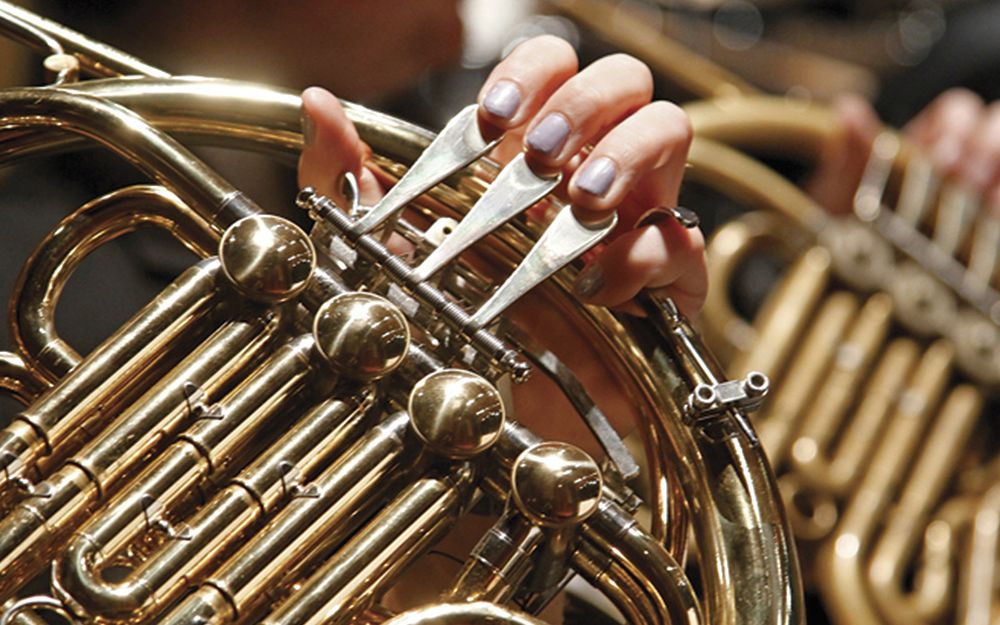
Experience a brilliant program packed with winter and holiday favorites the entire family can enjoy. Led by Maestro Guillermo Figueroa, with special appearances by a pair of guest conductors, we are thrilled to once again share the stage with The Santa Fe Youth Symphony, led by William Waag, as they join us for the first side-by-side performance of the season. You’ll also hear clarinetist Maya Mueller, the senior division winner of our 2025 Concerto Competition, and so much more. Join us and kick off your holiday season in style!
The runtime is approximately 1.5 hours, with one intermission. Please note: There is no pre-concert lecture before this performance.
Maya Mueller is a clarinetist currently pursuing her Master of Music degree at the Manhattan School of Music, where she studies with David Krakauer. She recently graduated from Vanderbilt University with a Bachelor of Music in Clarinet Performance, studying under Mariam Adam.
Originally from Rio Rancho, New Mexico, Maya is proud to represent her home state in this performance. She is especially grateful to her high school band director, Daniel Holmes of Cleveland High School, as well as her early instructors Michael Herrera and Michael Gruetzner, for their foundational support and encouragement throughout her musical development.
She was also a dedicated member of the Albuquerque Youth Symphony for four years, an experience that helped nurture her early passion for orchestral playing.
Maya was the recipient of the Linde B. Wilson Scholarship for musical performance during all four years at Vanderbilt. While at Vanderbilt, she performed extensively as a soloist, chamber musician, and orchestral clarinetist. Highlights include serving as principal clarinetist in the Vanderbilt Orchestra and Wind Symphony, and appearing as a featured soloist at the 2023 College Band Directors National Association conference. She also performed regularly with the Blair School of Music’s Contemporary Music Ensemble, including a collaboration with composer Wadada Leo Smith.
Her chamber music experience spans repertoire from Bartók to Valerie Coleman, with recent performances at prestigious summer festivals. At the Imani Winds Chamber Music Festival in New York, she performed at Lincoln Center and worked with clarinetists Mark Dover and Romie de Guise-Langlois. At the Zodiac Music Academy & Festival in France, Maya worked with clarinetist Kliment Krylovskiy, premiered a student composition, and performed in historic venues. She also held principal roles at the Eastern Music Festival in North Carolina.
Deeply committed to making music more accessible, Maya has taught in underserved communities across the U.S. and abroad. Her outreach includes volunteer teaching through the W.O. Smith Music School in Nashville, the Banda Sinfónica Integrada de las Américas in Colombia, and the Daraja Music Initiative in Tanzania.
Through this performance and beyond, Maya is honored to share her artistry with audiences and remains devoted to a career that bridges performance, education, and advocacy.
Selections from The Nutcracker
PETER ILYCH TCHAIKOVSKY
Born 1840, Votkinsk
Died 1893, St. Petersburg
In 1891, the Maryinsky Theatre in St. Petersburg approached Tchaikovsky with a commission for a new ballet. They caught him at a bad moment: At age 50, Tchaikovsky was assailed by worries that he had written himself out as a composer, and—to make matters worse—they proposed a story line that the composer found unappealing: They wanted to create a ballet based on the E.T.A. Hoffmann tale Nussknacker und Mausekönig, but in a version that had been retold by Alexandre Dumas as Histoire d’un casse-noisette, and then furthered modified by the choreographer Marius Petipa. This sort of Christmas fairy tale, full of imaginary creatures set in a confectionary dream-world of childhood fantasies, left Tchaikovsky cold, but he nonetheless accepted the commission.
Sidetracked by his American tour and his sister’s death, Tchaikovsky tried to resume work on the ballet when he returned to Russia. To his brother, he wrote: “The ballet is infinitely worse than The Sleeping Beauty—so much is certain.” The score was completed in the spring of 1892, and The Nutcracker was produced at the Imperial Theatre in St. Petersburg that December, only 11 months before the composer’s death at 53. At first, it had only modest success, but its popularity grew so steadily that Tchaikovsky reassessed what he had created: “It is curious that all the time I was writing the ballet I thought it was rather poor, and that when I began my opera [Iolanthe] I would really do my best,” he wrote. “But now it seems to me that the ballet is good, and the opera is mediocre.”
Tchaikovsky could have had no idea just how popular The Nutcracker would become: It is an inescapable part of our sense of Christmas. This concert offers a selection of movements from the ballet, largely characteristic dances. March (also known as March of the Toy Soldiers) plays during a lively party scene, which includes dancing, games, and merriment. The fiery Russian Dance (also called Trepak) is a wild Cossack dance, while La mère Gigogne (roughly equivalent to The Old Woman Who Lived in a Shoe, and also called Mother Ginger and her Children) features dancing clowns. Tchaikovsky, who was an admirer of Johann Strauss, loved waltzes, and this selection includes one of his finest, The Waltz of the Flowers from Act II.
—Program Note by Eric Bromberger
Concerto in A Major for Clarinet and Orchestra, K.622
WOLFGANG AMADEUS MOZART
Born 1756, Salzburg
Died 1791, Vienna
The second half of 1791 seemed, at least on the face of it, a promising time for Mozart. After several years of diminished popularity and income in Vienna, he suddenly found his music much in demand. He composed La clemenza di Tito as a commission for the coronation of Leopold II as King of Bohemia, followed by his completion of The Magic Flute and working on the Requiem Mass. Despite brief periods of illness, Mozart’s prospects seemed very bright.
It was during the first week of the heady success of The Magic Flute that Mozart composed his Clarinet Concerto; it would be his final masterpiece and his last completed work before his death, eight weeks short of his 36th birthday. During his first years in Vienna, Mozart had become friends with Anton Stadler (1753-1812), a fellow Freemason and a virtuoso clarinetist. He wrote three great works for Stadler that feature the clarinet: the Clarinet Trio (1786), the Clarinet Quintet (1789), and the Concerto. Stadler played the basset clarinet, an instrument of his own invention, which could play four pitches lower than the standard clarinet of Mozart’s day. That meant Mozart’s clarinet works could not be played on the contemporary clarinet, so they had to be rewritten to suit the range of that instrument. Subsequent modifications have given the modern A clarinet those four low pitches, and today we hear these works in the key in which Mozart originally intended them.
Mozart completed the Clarinet Concerto on October 7th, only 59 days before his death. It is of course tempting to make out premonitions of death in Mozart’s final instrumental work, and many have been unable to resist that temptation, but such conclusions must remain subjective. What we can hear in the Clarinet Concerto is some of the most graceful, noble, and moving music Mozart ever wrote. This is not a concerto that sets out to dazzle a listener’s ears with a soloist’s fiery technique (it has no cadenza) but rather music that, through its endless beauty, engages a listener’s heart. Mozart’s subdued orchestration (pairs of flutes, bassoons, and horns, plus strings) produces a smooth, warm, and understated sonority, ideal to accompany the clarinet and ideal for the restraint of the music itself. Mozart often has the first and second violins playing in unison, further purifying the sound of the orchestra.
At nearly half an hour, this piece is longer than almost all of Mozart’s other concertos. But its length brings with it a spaciousness that is very much a part of this music’s character. The opening Allegro establishes the concerto’s spirit immediately with its calm and lyrical opening idea. Solo clarinet takes up this theme at its entrance, and the soloist also has the graceful, arching second theme, a theme that—rather than contrasting sharply with the opening—remains very much within that same character. This may be a sonata-form movement, but it is one without conflict. Instead, it is endlessly graceful and expressive music, beautifully written for the clarinet.
The emotional center of this concerto is the Adagio. It is in this movement that one feels most strongly the concerto’s compelling combination of surface restraint and emotional depth; if one needs to make out premonitions of Mozart’s death, this movement’s intensity and spirit of gentle resignation offer the place to look. The opening measures bring some of the most expressive Mozart music ever wrote, as the smooth sound of the clarinet rises and falls above the strings’ murmuring accompaniment. Near the end the music rises to a climax, but it is an emotional rather than a dramatic climax (Mozart’s marking is only forte), and the music slips into silence.
The concluding rondo-finale dances and turns cheerfully along its 6/8 meter. The clarinet has wide skips and long, athletic runs throughout its range here, but even more impressive are the interludes between the return of the rondo theme, many of them beautifully shaded and hauntingly expressive.
—Program Note by Eric Bromberger
Pictures at an Exhibition
MODEST MUSSORGSKY
Born: 1839 Karevo, Russia
Died: 1881, Saint Petersburg
Pictures at an Exhibition, particularly its final movement, is widely considered one of Modest Mussorgsky’s (1839-1881) greatest works. He wrote the suite in three weeks’ time and dedicated it to Vladimir Stasov, a major figure on the Russian art scene in the late 19th century. The composition is Mussorgsky’s response to a display of Viktor Hartmann’s work at the Imperial Academy of Art.
Hartmann (1834-1873) was an artist and architect who met the composer between 1868 and 1870. The two became close friends immediately, largely due to their shared passion for creating Russian art that was rooted in Russian culture rather than in European traditions. Hartmann died suddenly of a brain aneurysm at age 39. The Russian art world was in shock, no one perhaps more so than Mussorgsky.
Hartmann’s friends organized an exhibition of 400 of the artist’s paintings, architectural drawings, and other works. Pictures at an Exhibition illustrates, musically, 10 of those illustrations. For many, it is the most well-known example of 19th-century program music—music that tells a story while, at the same time, depicts it sonically. The 10-movement suite includes the sounds of chickens, children, peasant carts moving through the mud, and more. Listeners are guided throughout the museum with sudden contrasts between movements as well as a few moments of reflection, not unlike if you were walking through a museum.
Originally written for solo piano, Maurice Ravel orchestrated Pictures in 1922, creating the edition most audiences have come to know and love.
The Promenade, which introduces the work, provides continuity between movements much like a hallway connects galleries in a museum; indeed, that was how the composer intended it to be heard. It also provides the underlying musical material for the final movement — The Great Gate of Kiev, known more formally in Ukraine as The Bogarty Gates or “Gate of Heroes at Kiev.”
For the exhibition that inspired Mussorgsky’s Pictures, Hartmann designed this Ukranian landmark in the “massive” Russian style, tall thick walls with a cupola shaped like a Slavonic helmet. His design was to commemorate the bravery of Tsar Alexander II’s men as they helped the monarch narrowly escape assassination, April 4, 1866.
While Hartmann’s designs for the gate in Kiev never materialized, Mussorgsky majestically depicted the grandeur he saw in Hartmann’s designs. For The Great Gate, the composer once again brings back the Promenade’s opening trumpet solo followed by brass choir, now retooled to showcase the tall, dense walls of the gate Hartmann proposed in his designs. The opening melody is now played by the entire brass section. Once the full orchestra joins in, the effect is a massive wall of sound, splendid and impressive, much as Hartmann’s Imperial Gate would have signaled to visitors arriving at the walled city of Kiev that they were about to enter a special place, one that was of great significance in the Imperial Russian Empire.
The Great Gate of Kiev is one of six portraits from the exhibition that Mussorgsky owned. By preserving it in sound and by expressing the emotions portrayed in Hartmann’s watercolors of life in 19th-century Italy, France, Poland, Russia and Ukraine, Mussorgsky shares with modern listeners a world now lost to war and the passing of time.
— Program note by Elisabet de Vallée
Festive Overture, op.96
DMITRI SHOSTAKOVICH
Born: September 25, 1906, Saint Petersburg, Russia
Died: August 9, 1975, Moscow, Russia
In the fall of 1954, the Bolshoi Theater Orchestra needed a new work to celebrate the October
Revolution for a concert that was to take place in three days time. Shostakovich agreed to write
something and immediately set to work.
As his friend Lev Lebedinsky related: “The speed with which he wrote was truly astounding. When he
wrote light music he was able to talk, make jokes and compose simultaneously, like the legendary
Mozart. He laughed and chuckled, and in the meanwhile, work was underway and the music was being written down.”
This commission — made at the peak of Stalin’s power — challenged the composer’s reputation for
producing high quality work “while you wait.” There are varying stories about its composition — that
Shostakovich locked himself in a room and passed pages under his door to copyists waiting outside to make parts for the players or that, as Lebedinsky recalled, the composer laughed and made jokes as he dashed off the main themes like he’d had it in his head all along. Whatever really happened, one thing is clear. The chaos and panic happening behind the scenes at the Bolshoi is simply not present in the work. Shostakovich’s Festive Overture flows naturally to the ear; it is full of good humor, yet polished, energetic, and truly festive.
Many listeners recognize this work from an unlikely source: television. Five years after Shostakovich’s
death, it was the musical theme of the 1980 Summer Olympics in Moscow.
Sleigh Ride
LEROY ANDERSON
Born 1908, Cambridge, MA
Died 1975, Westbury, CT
Leroy Anderson is best remembered for his lighter music intended for pops concerts, including The Syncopated Clock, Fiddle-Faddle, The Typewriter, Blue Tango, and Plink, Plank, Plunk! His Sleigh Ride has become an inescapable part of the way we observe Christmas, and its infectious rhythms and pleasing tunes can be heard in every shopping mall during the holiday season.
The story behind this famous music is an interesting one. During World War II, Anderson served as a translator for the army in Iceland. There was a housing shortage after the war as veterans returned from overseas, and Anderson, his wife, and their infant daughter had to move into a cottage in Woodbury, Connecticut, that was owned by his mother-in-law. It was in that cottage, during a heat wave in July 1948, that Anderson composed Sleigh Ride―perhaps in part as a way of escaping the heat. The composer noted that the entire piece is based on the steady rhythm of sleigh bells, and over that rhythm he offers a few perky, happy tunes that embody some of the fun of the Christmas season. Anderson composed Sleigh Ride purely as an orchestral piece, but two years later Mitchell Parish added words, and the music is sometimes heard in that version.
―Program Note by Eric Bromberger
Violin I
Elizabeth Baker
Andre Dos Santos Silva
Rebecca Callbeck
Barbara Morris
Lauren Avery
Nicolas Armer
Asmara Bhattacharya
Laurie Lopez
Violin II
Laura Chang
Anne Karlstrom
Justin Pollak
Carla Kountoupes
Hae-Jung Murphy
Sumiko Corley
Olivia Holland
Viola
Kim Fredenburgh
Sigrid Karlstrom
Michael Anderson
Luis De Vargas
Andrea Rutan
Tori Anderson
Cello
Lisa Collins
Ian Brody
Elizabeth Purvis
Sally Guenther
Quinn Boyak
Bass
Sam Brown
Frank Murry
Zachary Bush
Flute
Hyorim Kim
Abigail Grace
Skye Stone
Oboe
Elaine Heltman
Rebecca Ray
Kevin Vigneau
Clarinet
Luis Baez
Sarah Jaegers
Keith Lemmons
Bassoon
Elizabeth VanArsdel
Leslie Shultis
Tim Wells
Horn
Daniel Nebel
Andrew Meyers
Peter Erb
Sarah Schwenke
Trumpet
Sam Oatts
Addison Bosch
Brad Dubbs
Trombone
Christopher Buckholz
Lynn Mostoller
Bass Trombone
Dave Tall
Tuba
Richard White
Timpani
Ken Dean
Percussion
Scott Ney
Diana Sharpe
Griffin McCabe – SFS Youth Musician Ambassador
Harp
Bethany Boyak
Piano/Keyboards
Jessie Wenchieh Lo
Voice
John Tiranno