
February 21, 2027
4 PM | Lensic
Tchaikovsky & Brahms
The Santa Fe Symphony Orchestra
The Santa Fe Symphony Chorus
Guillermo Figueroa, Music Director
Carmen Flórez-Mansi, Choral Director
Brynn Marchiando, Trumpet
Program
BRAHMS
Schicksalslied, op. 54
OSKAR BÖHME
Trumpet Concerto, op. 18
Brynn Marchiando, Trumpet
TCHAIKOVSKY
Symphony No. 4 in F minor, op. 36
Runtime: Approx. 2 hours, with one intermission.
FULL CONCERT SPONSOR

CONCERT SPONSORS-IN-PART
Perry C. Andrews III & Scott Baker
REACH FOR THE STARS | BRYNN MARCHIANDO
Teresa Pierce – In Memory of Mort Morrison
CHORUS SPONSORS
Elizabeth & James Roghair
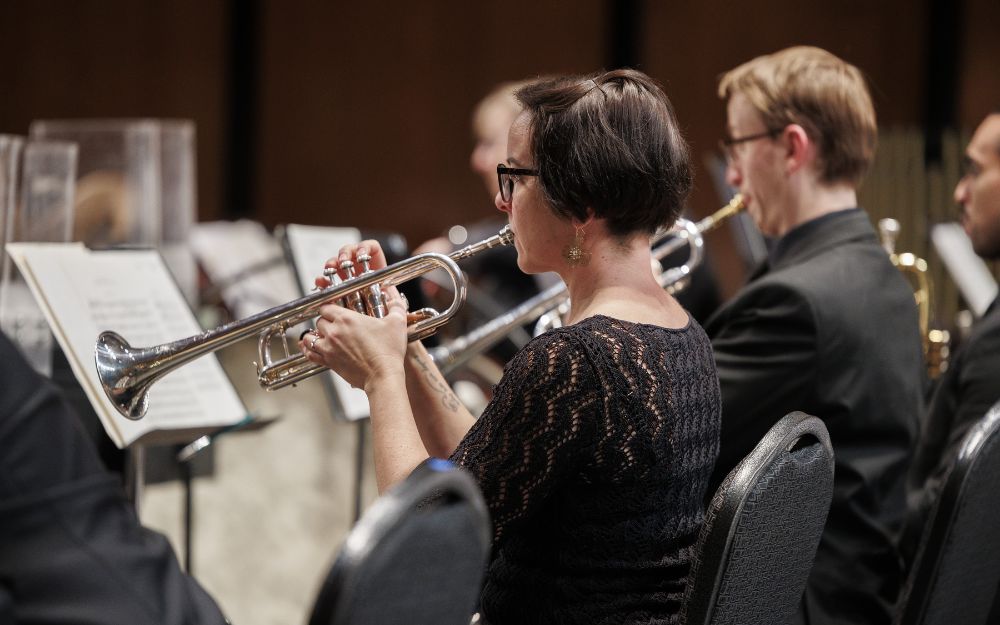
Luminous harmonies and driving melodies of Brahms’ choral-orchestral masterwork Schicksalslied begins this concert. This piece, inspired by poetry about Greek mythology, reflects the complicated relationship of fate, death and the afterlife. Next, Principal Trumpet Brynn Marchiando steps into the spotlight for Oskar Böhme’s Trumpet Concerto. The concert concludes with Tchaikovsky’s Fourth Symphony. This piece features all the hallmarks of his genius—gorgeous melodies, Romantic emotional intensity, and Russian folk song.
Brynn Marchiando lives and works in Albuquerque, New Mexico, as a performer and music educator. Inspired by her grandfather, who was also a trumpet player, she completed her undergraduate degree in Jazz Studies from the University of Denver Lamont School of Music, and her graduate degree in Trumpet Performance from the New England Conservatory of Music.
She has been a fellow at both the Tanglewood Music Center and Aspen Music Festival. Brynn has performed at the International Trumpet Guild Conference as both a jazz artist in the jazz competition in Thailand in 2005, as well as in a featured recital with her husband, John, as Marchianduo, in 2014. She currently plays 3rd /Associate Principal Trumpet in the New Mexico Philharmonic and Principal Trumpet in the Santa Fe Symphony.
Brynn enjoys playing all genres including traveling Broadway shows, jazz, and Latin bands. She has played with greats such as Bobby Shew and Clark Terry, and has appeared with Stiletto Brass Quintet, Fountain City Brass Band, Colorado Symphony Orchestra, Utah Symphony Orchestra and Santa Fe Opera. She is a founding member of the Breaking Brass Quintet.
Brynn is a professor at the University of New Mexico, where she teaches jazz improv, jazz theory and keyboard, and is a member of the faculty ensemble the Enchantment Brass Quintet. Brynn’s primary teachers include Alan Hood, Charles Schleuter, Raymond Mase and Kevin Cobb. She is a Shires Performing Artist.
Brahms was inspired to write Schicksalslied while on a vacation with friends in 1868 to the port of Wilhelmshaven. He came upon a copy of Friedrich Hölderlin’s 1799 novel Hyperion oder Der Eremit in Griechenland, which was full of longing for the glories of ancient Greece. In particular, Brahms was attracted to the poem Hyperions Schicksalslied (“Hyperion’s Song of Fate”), which draws a sharp contrast between the serenity of the life of the gods and the unhappy condition of humankind. The work would take him three years to complete: He did not finish it until May 1871, and he led the first performance in Karlsruhe on October 18, 1871.
Hölderlin’s poem is an unusual one, and the fact that Brahms was so struck by it tells us much about the composer’s view of mankind. His vision of human existence was dark, and he was especially struck by Hölderlin’s contrast between the life of the gods, a life full of soft breezes and gentle music, and the condition of man, who “ falls . . . like water hurled from crag to crag, down into endless uncertainty.”
Schicksalslied opens with a depiction of the vision of the gods, but rather than being majestic, their existence is luminously calm. The music begins with a long orchestral prelude in E-flat major, and Brahms marks this beginning Langsam and sehnsuchtvoll: “Slow and full of longing.” The chorus’ entrance preserves the serenity of the opening, where “Free from destiny, as the sleeping babe, the celestial beings breathe.” Things change sharply in the third and final stanza. On quietly dissonant wind chords, the music pivots, and suddenly we plunge into an Allegro in C minor that describes the bleak human condition.
Having laid out such different visions, Brahms then faced the difficult problem of how to conclude. The chorus remains silent, and the orchestra closes out Schicksalslied by recalling the orchestral prelude. Brahms transposes the music into C major here, but the most important change is that the quiet timpani that punctuated the prelude is now eliminated in the postlude, and its absence contributes to the serenity of the ending, which ends on a quiet C-major chord.
This makes for a consoling finale, although a not altogether satisfactory one. He confessed to a friend: “I had already gone as far as writing something for the chorus, but it didn’t work out. It may turn out to be a miscarried experiment, but such grafting would only result in nonsense.” After the final chord has softly faded, we are left with the memory of the sharp clash between the golden glow of the beginning and the black tumult of the central episode. Perhaps the gap between those visions was so wide and Brahms’ vision of the human condition so dark, that there could be no satisfactory resolution of Hölderlin’s fragmented vision of existence.
Very few people have heard of this superb concerto or of its composer. Oskar Böhme learned to play the trumpet from his father, an amateur musician, and quickly became a virtuoso on the instrument. In 1894, at the age of 24, he joined the orchestra of the Royal Hungarian Opera House in Budapest, and three years later he moved to Saint Petersburg, where he would spend the remainder of his life. Böhme wrote primarily for his own instrument or for ensembles of brass instruments. His best-known works are this Trumpet Concerto, composed in 1899, and a Trumpet Sextet, which dates from 1911.
After what might seem a distinguished career, Böhme’s life ended horribly. In the Great Terror of the 1930’s, Stalin set out to purge Russia of forces he suspected were hostile to the Communist Party. Millions of people died, and foreigners in Russia fell under particular suspicion. Although he had lived and made his career in Russia for over forty years, Böhme was arrested and subjected to a mock trial. Under torture by the NKVD, Stalin’s secret police, Böhme confessed his “guilt” and was executed by a firing squad at the age of 68.
The work gives some idea of how fine a trumpeter he must have been. It is in the expected three movements in a fast-slow-fast sequence, and Böhme asks that the soloist demonstrate the full range of the trumpet’s capabilitie. The concerto is compact (only about 15 minutes), and the Allegro moderato opens with a brief orchestral introduction before the soloist enters on a flowing and attractive melody. Quickly, the music becomes full of blistering runs often set high in the trumpet’s register. A cantabile second theme brings a measure of repose, and Böhme alternates these ideas before closing with a terrific cadenza.
The second movement, Andante religioso, emphasizes the lyric side of the trumpet, with the soloist required to sustain a singing line, while the Allegro scherzando finale is a rondo set in 6/8. The solo trumpet dances nimbly along that meter on an ingratiating rondo tune that makes many welcome reappearances before the concerto rushes to its exciting conclusion.
The Fourth Symphony dates from the most tumultuous period in Tchaikovsky’s difficult life, and its composition came from a moment of agony. As he worked on this score, one of his students at the Moscow Conservatory—a disturbed young woman named Antonina Ivanovna Milyukova —declared her love for him. Tchaikovsky put her off as gently as he could, but she persisted, even threatening suicide at one point. As fate would have it, Tchaikovsky was also at work on his opera Eugene Onegin at this time and was composing the scene in which the bachelor Onegin turns down the infatuated young Tatiana, to his eventual regret. Struck by the parallel with his own situation—and at some level longing for a “normal” life with a wife and children—Tchaikovsky did precisely the wrong thing: He agreed to Antonina’s marriage proposal.
The marriage was an instant disaster, and he retreated to St. Petersburg, collapsing into two days of unconsciousness. His doctors prescribed complete rest, so he abandoned his teaching post in Moscow. It was in San Remo, Italy, on the sunny shores of the Mediterranean, that he completed the Fourth Symphony in January 1878.
This symphony has all of Tchaikovsky’s considerable virtues—great melodies, primary colors, and soaring climaxes—infused with superheated emotion. The symphony opens with a powerful brass fanfare, which Tchaikovsky describes as “fate, the inexorable power that hampers our search for happiness.” The principal subject of this movement, however, is a dark, stumbling waltz in 9/8 introduced by the violins: “The main theme of the Allegro describes feelings of depression and hopelessness. Would it not be better to forsake reality and lose oneself in dreams?” This long opening movement has an unusual structure: Tchaikovsky builds it on three separate theme groups which evolve through some unusual harmonic relationships.
After so turbulent a beginning, the two middle movements bring much-needed relief. The Andantino, in ternary-form, opens with a plaintive oboe solo and features
a more animated middle section. Tchaikovsky described it: “Here is the melancholy feeling that overcomes us when we sit weary and alone at the end of the day. The book we pick up slips from our fingers, and a procession of memories passes in review . . .”
The scherzo has deservedly become one of Tchaikovsky’s most popular movements. It is a tour de force for strings (which play pizzicato throughout), with crisp interjections first from the woodwinds and then from brass. The composer notes: “There is no specific feeling or exact expression in the third movement. Here are only the capricious arabesques and indeterminate shapes that come into one’s mind with a little wine . . .”
Out of the quiet close of the third movement, the finale explodes to life. The composer described this movement as “the picture of a folk holiday” and said, “If you find no pleasure in yourself, look about you. Go to the people. See how they can enjoy life and give themselves up entirely to festivity.” Marked Allegro con fuoco, this movement alternates its volcanic opening sequence with a gentle woodwind tune, “In the field there stood a birch tree.” At the climax, however, the fate-motto from the first movement suddenly bursts forth: “But hardly have we had a moment to enjoy this when Fate, relentless and untiring, makes his presence known.”