September 13, 2026
4 PM | Lensic
Season Opener: Beethoven’s Fifth
The Santa Fe Symphony Orchestra
Guillermo Figueroa, Music Director
Inna Faliks, Piano
Program
BEETHOVEN
Symphony No. 5 in C Minor, op. 67
TCHAIKOVSKY
Piano Concerto No. 1 in B-flat Minor, op. 23
Inna Faliks, Piano
Runtime: Approx. 1 hour 35 minutes, with one intermission.
FULL CONCERT UNDERWRITER

FULL CONCERT SPONSOR

REACH FOR THE STARS | INNA FALIKS
Philip A. Martin
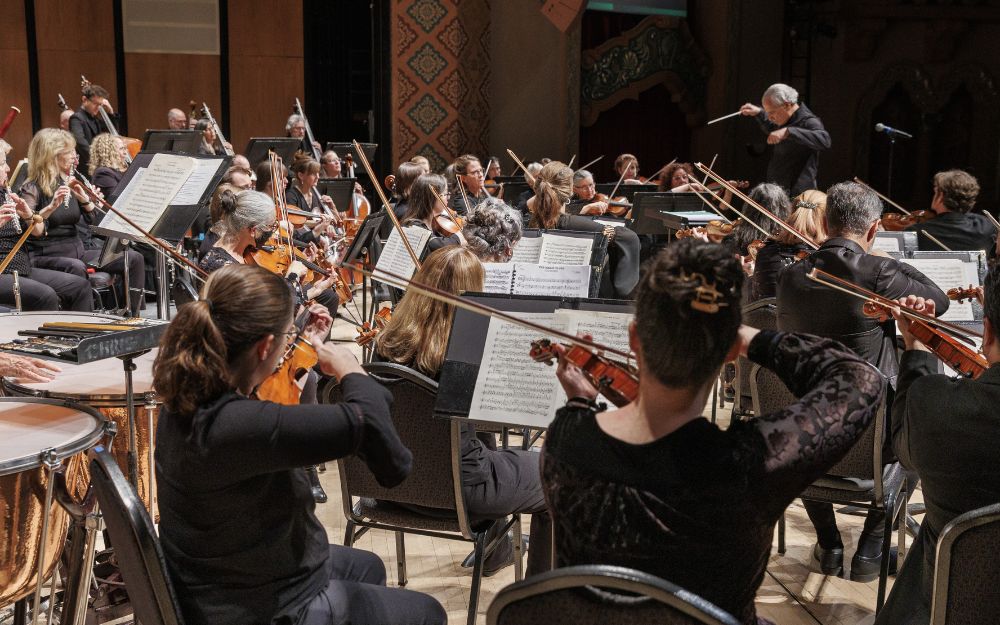
The Santa Fe Symphony’s 43rd Season kicks off with a concert featuring two iconic works. The concert opens with arguably the most famous four notes in music history. Beethoven’s Fifth Symphony is a rousing declaration that the 2026-2027 Season is not to be missed! Finally, pianist Inna Faliks and The Symphony perform Tchaikovsky’s majestic and beautiful Piano Concerto No. 1.
“Adventurous and passionate” (The New Yorker) Ukrainian-born pianist Inna Faliks has established herself as one of the most communicative, and poetic artists of her generation. She is renowned internationally for her commanding performances in standard piano repertoire, as well genre-bending projects, and work with contemporary composers.
Ms. Faliks’s distinguished career has brought thousands of recitals and concerts throughout the US, Asia, and Europe. Recent seasons have included performances at the Ravinia Festival, National Gallery of Art, Alice Tully Hall, the Wallis Annenberg Center. And the Broad Stage. In China she has appeared at the most important concert halls: the Beijing Center for Performing Arts, Shanghai Oriental Arts Theater and Tianjin Grand Theater. She at the Festival Internacional de Piano in Mexico, the Fazioli Series in Italy, Israel’s Tel Aviv Museum, Portland Piano Festival, and Camerata Pacifica. She has performed at Carnegie Hall’s Weill Concert Hall, the Metropolitan Museum of Art, the International Keyboard Festival in New York, Bargemusic Here and Now, and Chautauqua, the Salle Cortot in Paris, Moscow’s Tchaikovsky Hall and at many important festivals including Verbier, Mondo Musica Cremona, Brevard, Taos, Gilmore, Music in the Mountains, Brevard, Taos, and returns regularly to Newport Classical and the Peninsula Music Festival.
Since her acclaimed teenage debut with the Chicago Symphony Orchestra, she has been a frequent guest soloist with symphony orchestras. 2024 brought debuts with Tokyo Sinfonia in Oji Hall and with the New Haven Symphony Orchestra under Perry So. She premiered Clarice Assad’s Lilith concerto with Richard Scerbo and Inscape at the National Gallery of Art with additional performances under Thomas Heuser with the San Juan Symphony. Fall 2025 brought her debut with the New West Symphony under Michael Christie in Beethoven’s Choral Fantasy and the premiere of Gabriel Prokofiev’s groundbreaking Concerto for Synthesizer and Orchestra with the Orquestra Sinfonica do Porto Casa da Musica in Porto, Portugal featuring Inna on the Minimoog, conducted by Andrew Gourlay.
Among many other performances with orchestra, she has appeared with the Greensboro Symphony under Dmitry Sitkovetsky, the Memphis Symphony with Robert Moody, the Erie Symphony with Daniel Meyer, Santa Barbara Symphony with Nit Kabaretto, Williamsburg Symphony, the Wintergreen Festival, and in concerti under the batons of such renowned conductors as Leonard Slatkin, Keith Lockhart, Edward Polochick, and Neal Stuhlberg. A committed chamber musician, she has had notable collaborations with Gilbert Kalish, Ron Leonard, Fred Sherry, Ilya Kaler, Colin Carr, Wendy Warner, Clive Greensmith, Antonio Lysy, and Rachel Barton Pine.
Inna Faliks has had a strong commitment to contemporary music giving premieres of works composed for and dedicated her by Billy Childs, Timo Andres, Richard Danielpour, Paola Prestini, Ljova, Clarice Assad, and Peter Golub. In her recording, “Reimagine Beethoven and Ravel,” contemporary composes respond to the Beethoven Bagatelles and Ravel’s Gaspard de la Nuit. In “13 Ways of Looking at the Goldberg” composers’ created variations based on Bach’s masterpiece. She performed and recorded unknown piano works of the Russian poet Boris Pasternak. A one-woman show led to “Polonaise-Fantaisie, Story of a Pianist”, an autobiographical monologue for pianist and actress, presented as a solo recital in New York’s Symphony Space, the Accademia Musicale Chigiana in Italy and for her London debut at JE3 Arts Centre. In 2023 her acclaimed memoir, Weight in the Fingertips: A Musical Odyssey from Soviet Ukraine to the World Stage was published by Backbeat / Globe Pequot.
Inna Faliks has been featured on radio and television throughout the world. She co-starred with Downton Abbey’s Lesley Nicol in “Admission – One Shilling,” a play for pianist and actor based on the life of the great British pianist, Dame Myra Hess. Her most recent recording, “Manuscripts Don’t Burn,” was released in 2024 with premiers by Maya Miro Johnson and Veronika Krauss.. Prior releases have received critical praise and named to annual “best of” lists. For her Beethoven CD release on MSR, WTTW called Faliks “High priestess of the piano, concert pianist of the highest order, as dramatic and subtle as a great stage actor.”
Faliks is founder and curator of Music/Words, now based at the Wende Museum in Los Angeles: an award-winning poetry-music series in collaboration with some of the nation’s most distinguished poets, frequently.
A past winner of many prestigious competitions, Inna Faliks is currently Professor of Piano and Head of Piano at UCLA. As a writer, she has been published by Los Angeles Times and Washington Post.
Beethoven’s Fifth Symphony surrounds us: as background music for commercials, as the symbol for Victory in World War II, even as the stuff of jokes. Its first four notes are the most famous in classical music, and the piece is certainly the most famous symphony ever written.
Music so white-hot in intensity and so universal in appeal cries out for interpretation, and over the past two centuries, many have been ready to tell us what this symphony “means.” To some, it is Fate knocking at the door. To one 19th-century critic, it told the story of a failed love affair. Others see it as the triumph of reason over chaos and evil. But, engaging as such interpretations are, they tell us more about the people who make them than about the music itself. The sad truth is that this music is so over-familiar that we have almost stopped listening to it: The opening rings out, and our minds go on automatic pilot for the next 30 minutes. We have lost the capacity to listen to the Fifth purely as music, to comprehend it as the astonishing and original musical achievement that it is.
Beethoven made the first sketches for this symphony in 1804, soon after completing Eroica, but he did not begin work in earnest until after finishing the Fourth in 1806. He completed the score in 1807, and the first performance took place on December 22, 1808, six days after his 38th birthday.
The stark opening of the Allegro con brio, both very simple and charged with volcanic fury, provides the musical content for the entire movement. That (seemingly) simple figure saturates the first movement, giving it extraordinary unity. Those four notes shape the main theme, generate the rhythms, and pulse insistently in the background; they even become the horn fanfare that announces the second theme. One of the most impressive features of this movement is how short it is: Of Beethoven’s symphonies, only the Haydnesque First Symphony has a shorter first movement. The power unleashed at the beginning is unrelenting, and this movement hammers to a close with the issues it raises still unresolved.
The Andante con moto contrasts two themes. Violas and cellos sing the broad opening melody in A-flat Major; Beethoven reportedly made 11 versions of this theme before he got the one he wanted. The second subject, in heroic C major, blazes out in the brass, and Beethoven simply alternates these two themes, varying each as the movement proceeds. The third movement returns to the C-minor urgency of the beginning. It seems at first to be in scherzo-and-trio form, with lower strings introducing the sinuous opening idea. But horns quickly sound the symphony’s opening motto, and the
movement never quite regains its equilibrium: The trio, with lumbering fugal entries in the strings, subtly incorporates the opening rhythm as well. At just the point where one anticipates a return to the scherzo comes one of the most famous, and original, moments in music.
Instead of going back, Beethoven pushes ahead. Bits of the scherzo flit quietly over an ominous pedal, and suddenly the final movement—a triumphant march in C major— bursts to life. This dramatic moment has invariably been compared to sunlight breaking through dark clouds. Beethoven’s scoring here reminds us of something easy to overlook: his concern with instrumental color. The march theme is announced by a full orchestra that includes three trombones (their first use in a symphony), and Beethoven employs a piccolo and contrabassoon to good effect here as well. Near the middle of this movement, Beethoven brings back some of the scherzo, which briefly—and darkly—slows progress before the triumphant march bursts out again to drive the symphony to its close. The coda itself is extremely long, and the final cadence, extended almost beyond reason, is overpowering.
No matter how familiar this symphony is, no matter how overlain it has become with extramusical associations, the music remains extraordinary. Heard for itself, free of the cultural baggage it has acquired over the years, Beethoven’s Fifth Symphony is as original, powerful, and furious today as it was when it burst upon an unsuspecting audience on a cold winter night in Vienna two centuries ago.
When Tchaikovsky was working on this concerto in 1874, he was a young professor at the Moscow Conservatory. Only modestly talented as a pianist and insecure about his handling of larger forms, Tchaikovsky sought the advice of Nicholas Rubinstein, head of the Conservatory and the man to whom he intended to dedicate the work. Rubinstein listened in silence as Tchaikovsky played, and then there burst from Rubinstein’s mouth a torrent of words. According to the composer, “It seems that my concerto was utterly worthless, absolutely unplayable. Certain passages were so commonplace and awkward they could not be improved, and the piece as a whole was bad, trivial, and vulgar. I had stolen this from somebody and that from somebody else, so that only two or three pages were good for anything and all the rest should be wiped out or radically rewritten.”
Tchaikovsky refused to change a note, erased the dedication to Rubinstein, and instead dedicated the concerto to the German pianist conductor Hans von Bülow, who had championed his music. Bülow promptly took the concerto on a tour of the United States, and the piece was heard for the first time in Boston on October 25, 1875.
It was a huge success, and Bülow played it repeatedly in this country to rhapsodic reviews. A Boston critic described the concerto as an “extremely difficult, strange, wild, ultra-modern Russian Concerto,” but in Russia the composer read the reviews and was beside himself with happiness: “Think what
healthy appetites these Americans must have! Each time Bülow was obliged to repeat the whole finale of my concerto! Nothing like that happens in our country.” Rubinstein eventually saw the error of his early condemnation and became one of the concerto’s great champions. In 1889, perhaps more aware of Rubinstein’s criticisms than he cared to admit, Tchaikovsky did put the piece through a major revision, and it is in this form that we know it today.
The concerto has one of the most dramatic beginnings in all the literature, ringing with horn fanfares and cannonades of huge piano chords, followed by one of Tchaikovsky’s most well-known phrases, in which the horn fanfare is transformed into a flowing melody for strings. This introductory section has many quirks. It is in the “wrong” key (D-flat Major), and it never returns in any form: Tchaikovsky simply abandons all this tremendous material when he gets to the main section of the movement. This “real” beginning, marked Allegro con spirito, is finally in the correct key of B-flat minor, and the piano’s skittering main subject is reportedly based on a tune Tchaikovsky heard a blind beggar whistle at a fair in the Ukraine. Tchaikovsky wrote to his patroness, Madame von Meck: “It is curious that in [the Ukraine] every blind beggar sings exactly the same tune with the same refrain. I have used part of this refrain in my pianoforte concerto.” The expected secondary material—a chorale-like theme for winds and a surging, climbing figure for strings—evades expectations by including multiple cadenzas for the soloist in this movement. The piano writing is of the greatest difficulty, much of it in great hammered octaves, and the movement drives to a dramatic close.
The Andantino semplice is aptly named, for this truly is simple music in the best sense of that term: Over pizzicato chords, solo flute sings the gentle main theme, an island of calm after the searing first movement. A scherzo-like central episode marked Prestissimo leads to the return of the opening material and a quiet close. The finale, Allegro con fuoco, is also well named, for here is music full of fire. It is a rondo based on the piano’s nervous, dancing main theme, and while calmer episodes break into this furious rush, the principal impression this music makes is of white-hot energy, and the
piece rushes to a knockout close that is just as impressive to audiences today as it was to the first audience in 1875.
Violin I
David Felberg
Ruxandra Marquardt
Elizabeth Young
Alan Mar
Carol Swift
André Dos Santos Silva
Rebecca Callbeck
Natalie Frantz Wade
Carmelo de Los Santos
Sarah Lee
Violin II
Nicolle Maniaci
Sheila McLay
Laura Chang
Anne Karlstrom
Lidija Peno-Kelly
Justin Pollak
Carla Kountoupes
Valerie Turner
Gloria Velasco
Viola
Kimberly Fredenburgh
Laura Steiner
Lisa DiCarlo
Allegra Askew
Christine Rancier
Sigrid Karlstrom
Michael Anderson
Erin Dryer
Cello
Dana Winograd
Jessamyn Fry
Allison Rich
Melinda Mack
Lisa Collins
Amy Huzjak
Carla Lehmeier
Bass
Terry Pruitt
Sam Brown
Frank Murry
Mark Tatum
Keith Lokey
Flute
Jesse Tatum
Laura Dwyer
Hyorim Kim
Oboe
Amanda Talley
Rebecca Ray
Clarinet
Lori Lovato
Emily Erb
Bassoon
Stefanie Przybylska
Levi Walsh
Tim Wells
Horn
Peter Erb
Andrew Meyers
Michael Lombardi
Allison Tutton
Trumpet
Brynn Marchiando
Sam Oatts
Trombone
Noah Eder
Lynn Mostoller
Bass Trombone
Dave Tall
Timpani
Ken Dean