March 21, 2027
4 PM | Lensic
Beethoven & Korngold
The Santa Fe Symphony Orchestra
Members of The Santa Fe Youth Symphony Orchestra
Guillermo Figueroa, Music Director
William Waag, Director of Youth Orchestras
Benjamin Beilman, Violin
Program
BEETHOVEN
Symphony No. 6 in F Major, op. 68, “Pastoral”
KORNGOLD
Violin Concerto in D Major, op. 35
Benjamin Beilman, Violin
DVOŘÁK
Carnival Overture, op. 92
Side-By-Side with
Members of The Santa Fe Youth Symphony Orchestra
Runtime: Approx. 1 hour and 45 minutes, with one intermission.
FULL CONCERT SPONSORS


CONCERT SPONSOR-IN-PART

REACH FOR THE STARS | BENJAMIN BEILMAN
Zella & Lawrence Cox
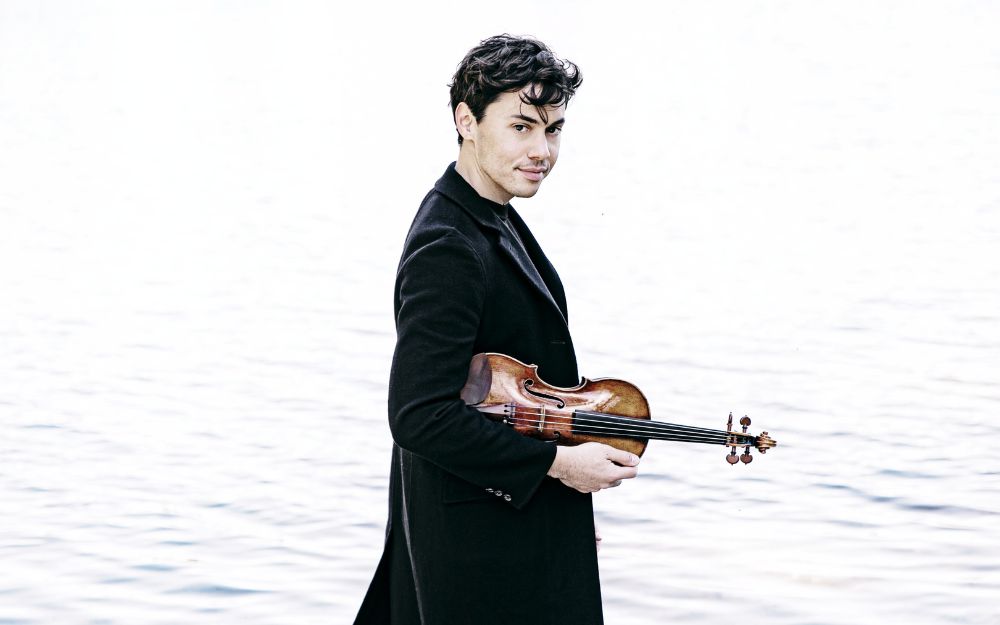
Benjamin Beilman, one of the leading violinists of his generation, makes his Santa Fe Symphony debut with Korngold’s Violin Concerto. Famous for his film scores of the 1930s and 40s, Korngold composed his Violin Concerto with the same sophistication and romanticism he brought to Hollywood. The concert opens with Beethoven’s Pastoral Symphony. The master composer takes listeners on a pleasant stroll through the sunny countryside with birds singing above. Closing the program is Dvorak’s Carnival Overture, an entertaining kaleidoscope of themes and colors portraying a celebration of life, and will feature members of The Santa Fe Youth Symphony Orchestra.
Benjamin Beilman has earned international acclaim for his passionate performances and distinctive tone—The New York Times called it “muscular with a glint of violence,” while The Strad praised its “pure poetry.” Praised for his instinctive sense of form and color, he brings a balance of elegance and surprise to his playing—uncovering new depths in familiar works and expanding the violin’s expressive range through his commitment to contemporary music.
Benjamin’s 2025/26 season highlights include his subscription debut with the Berlin Philharmonic, following a successful US tour with orchestra, replacing Hilary Hahn. He also makes appearances with the Minnesota Orchestra performing Szymanowski’s Violin Concerto No. 1, Dresden Philharmonic performing Mozart No. 5, Antwerp Symphony performing Saariaho’s Graal théâtre, Solistes Européens Luxembourg performing Beethoven, Nouvel Ensemble Moderne performing Berg, and the Nashville Symphony performing Britten. He will also curate, stage, and lead two chamber music programs at Sun Valley Music Festival and continue his ongoing recital partnership with pianist Steven Osborne. In the Summer, he embarks on a month-long tour of Australasia, including appearances with the Sydney Symphony and Tasmanian Symphony with Tabitha Berglund, West Australian Symphony with Anja Bihlmaier, and the Auckland Philharmonia with Giordano Bellincampi.
Last season saw Benjamin’s debut with the Berlin Philharmonic and Kirill Petrenko on tour in the US, as well as returns to the Chicago Symphony, Cincinnati Symphony, Oslo Philharmonic, and Antwerp Symphony. He also made his debut with the Belgian National Orchestra in a performance of Stravinsky’s concerto, and with the Tokyo Metropolitan Symphony performing Korngold.
In past seasons, Benjamin has performed with many major orchestras worldwide including the Philadelphia Orchestra, San Francisco Symphony, Chicago Symphony, Rotterdam Philharmonic, London Philharmonic, Trondheim Symphony, Oslo Philharmonic, Taipei Symphony, Frankfurt Radio Symphony, Zurich Tonhalle, Sydney Symphony, and Houston Symphony. He has also extensively toured Australia in recital under Musica Aviva, and in 2022, became one of the youngest artists to be appointed to the faculty of the Curtis Institute of Music.
In recent seasons Beilman’s commitment to and passion for contemporary music has led to new works written for him by Frederic Rzewski (commissioned by Music Accord), and Gabriella Smith (commissioned by the Schubert Club in St. Paul, and the San Francisco Conservatory of Music). He has also given multiple performances of Jennifer Higdon’s violin concerto, and recorded Thomas Larcher’s concerto with Hannu Lintu and the Tonkünstler Orchester, as well as premiered Chris Rogerson’s Violin Concerto (“The Little Prince”) with the Kansas City Symphony and Gemma New.
Conductors with whom he has worked include Elim Chan, Yannick Nézet-Séguin, Cristian Măcelaru, Lahav Shani, Andrés Orozco-Estrada, Semyon Bychkov, Krzysztof Urbański, Ryan Bancroft, Gemma New, Karina Canellakis, Jonathon Heyward, Juraj Valčuha, Han-Na Chang, Roderick Cox, Rafael Payare, Osmo Vänskä, and Giancarlo Guerrero.
Beilman studied at the Curtis Institute of Music with Ida Kavafian and Pamela Frank, and with Christian Tetzlaff at the Kronberg Academy, and has received many prestigious accolades including a Borletti-Buitoni Trust Fellowship, an Avery Fisher Career Grant and a London Music Masters Award. He has also recorded works by Stravinsky, Janáček and Schubert for Warner Classics. He performs with the ex-Balaković F. X. Tourte bow (c. 1820), and plays the “Ysaÿe” Guarneri del Gesù from 1740, generously on loan from the Sasakawa Music Foundation.
The Sixth Symphony is unique among Beethoven’s symphonies because it appears to be program music. Beethoven gave it the nickname Pastoral and further headed each movement with a descriptive title that seems to tell a “story”: the arrival in the country, impressions beside a brook, a peasants’ dance which is interrupted by a thunderstorm, and a concluding hymn of thanksgiving once the storm has passed. Some have claimed that romantic music begins with the Pastoral; they see it as a precursor of such examples of musical painting as Berlioz’s Symphonie Fantastique, Mendelssohn’s fairyland scenes, and Liszt’s tone poems. Some have tried to stage it, complete with characters, costumes, and scenery.
This symphony’s first movement (“Cheerful impressions on arriving in the country”) is built on two completely relaxed themes; these do not offer the contrast that lies at the heart of sonata form, but instead create two complementary “cheerful impressions.” One of the other unusual features of this movement is Beethoven’s use of the second measure of the opening theme in so many ways: as theme, as accompaniment, as motor rhythm. This simple falling figure saturates the movement, and over its ostinato-like repetitions Beethoven works some wonderful harmonic progressions, all aimed at preserving this movement’s sense of calm.
The second movement, “Scene by the Brook,” is also in a sonata form built on two themes. The title may imply some dramatic action, but there is none here. Over murmuring lower strings, with their suggestion of bubbling water, the two themes sing gracefully. The movement concludes with three brief bird calls, which Beethoven names specifically in the score: nightingale (flute), quail (oboe), and cuckoo (clarinet).
Despite the composer’s protests to the contrary, the third and fourth movements do offer pictorial representations in sound. The scherzo (“Peasants’ merrymaking”) is a portrait of a rural festival; its vigorous trio echoes the heavy stamping of a peasant dance. Tremulous strings and distant murmurings lead to the wonderful storm, which remains the best musical depiction ever of a thunderstorm, with great crashes of thunder in the timpani and lightning flashing downward in the violins. One literal-minded early critic complained that this was the only storm he had ever heard of where the thunder came before the lightning.
Gradually the storm moves off, and the music proceeds directly into the last movement, where solo clarinet and horn outline the tentative call of a shepherd’s pipe in the aftermath of the storm. Beethoven then magically transforms this call into his serene main theme, given out by the violins. If ever there has been music that deserved to be called radiant, it is this singing theme, which unfolds like a rainbow spread across the heavens. The finale is a moderately paced rondo (Beethoven’s marking is Allegretto). Along the way appear secondary themes that once again complement the mood of the rondo theme, and at the end a muted French horn sings this noble melody one last time.
Probably no child composer, including Mozart, has been as precocious as Erich Wolfgang Korngold. The son of a leading music critic in Vienna, the boy demonstrated his incredible gift very early. His cantata Gold, composed when he was 10, amazed Mahler, and those impressed by his abilities included Richard Strauss and Puccini, who said: “That boy’s talent is so great, he could easily give us half and still have enough left for himself!” Korngold’s opera Die tote Stadt, composed when he was 20, received simultaneous premieres in Hamburg and Cologne, and in the 1920s he was one of the most admired young composers in Europe.
In 1934, his career took a completely unexpected turn, one that would redefine him as a composer. The director and producer Max Reinhardt invited Korngold to Hollywood to arrange Mendelssohn’s A Midsummer Night’s Dream for use in a film, and Korngold discovered that his neo-romantic idiom was perfectly suited to the movies. With the rise of the Nazis in Europe, Korngold moved his family to Hollywood, and over the next decade he wrote a succession of brilliant film scores. After the war, Korngold tried to return to writing “serious” music, but he found that he could not escape his past as a film composer.
A distinguishing feature of this “serious” composition is that it is largely based on music Korngold had written for movies produced during the late 1930s. A curious problem faced film composers of that era: They might write a wonderful score that would be heard while the film was in distribution, and then it would vanish into studio archives, never to be heard again. Korngold felt that some of his film music (particularly the scores for adventure films starring Errol Flynn) was too good to lose, and he used it as the basis of the concerto.
The concerto is in the expected three-movement form, with the solo violin entering in the first instant on a theme drawn from Another Dawn, a 1937 Errol Flynn film. This theme arcs grandly upward and then soars dramatically; it is perfectly suited to show off the violin and the violinist. The second subject is taken from Korngold’s music for the film Juarez (1939). The movement is classical form, complete with development and recapitulation of these ideas, a cadenza, and a grand close.
Korngold titled the second movement Romance, a title without formal meaning; it suggests music of an expressive atmosphere. The main theme here comes from the film Anthony Adverse (1936), for which Korngold won an Oscar. The finale, a rondo marked Allegro assai vivace, sounds as if it was written specifically for Heifetz’s talents: After a dizzying beginning, the movement is built on music from yet another Errol Flynn film, The Prince and the Pauper (1937). In the movie, this theme accompanied the hunt for the royal seal. Here it becomes the basis for a brilliant concluding movement full of violinistic fireworks, and an ending guaranteed to set hearts racing.
Composed between July and September 1891, Carnival Overture opens with all the excitement and color of Dvořák’s Slavonic Dances. The music explodes to life with a great blast of energy, which is quickly followed by a lilting second subject in the strings that Dvořák marks molto espressivo. Things seem set to proceed in standard sonata form when Dvořák springs a surprise, pausing to insert a long slow section marked Andantino con moto. A French horn call introduces this gentle interlude: English horn, flute, and solo violin sing quietly over muted strings, and solo clarinet sounds Dvořák’s “nature theme.” There are some lovely sounds in this quiet interlude, set off by subtle use of the tambourine. Suddenly the wild energy of the opening return to lead matters back into the development, and Dvořák’s Carnival Overture concludes with a rush of energy worthy of its name.
Dvořák led the premiere at a farewell concert in Prague on April 28, 1892, just before leaving for America. He conducted the same music at his opening concert in New York on October 21, 1892, in that city’s brand-new concert hall, which would soon be named Carnegie Hall.