January 17, 2027
4 PM | Lensic
European Melodies
The Santa Fe Symphony Orchestra
Guillermo Figueroa, Music Director
Anna Geniushene, Piano
Program
MOZART
Overture to Don Giovanni
GRIEG
Piano Concerto in A Minor, op. 16
Anna Geniushene, Piano
MENDELSSOHN
Symphony No. 3 in A Minor, op. 56, “Scottish”
Runtime: Approx. 1 hour 45 minutes, with one intermission.
CONCERT SPONSORS-IN-PART
Dr. Thomas McCaffrey
Kay & Neel Storr, Storr Family Endowment Fund
REACH FOR THE STARS | ANNA GENIUSHENE
Allegra & James Derryberry
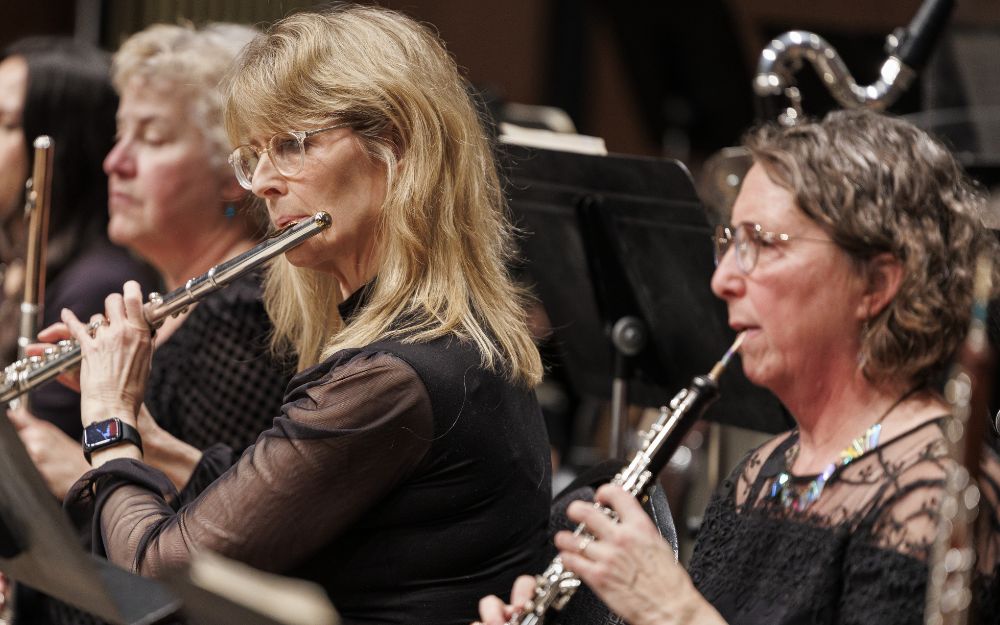
The beauty of Europe comes to the Santa Fe stage! The concert kicks off with the Overture to Mozart’s Don Giovanni, based on the legend of Don Juan and set in Seville, Spain. Next, pianist Anna Geniushene joins Maestro Figueroa and The Symphony for Grieg’s Piano Concerto, with melodies that evoke the composer’s Norwegian heritage. Finally, Mendelssohn’s “Scottish” Symphony will leave you with visions of the ruins of Holyrood Palace in Edinburgh that inspired the work.
Anna Geniushene made a powerful impression at the 2022 Van Cliburn International Piano Competition, earning the silver medal with performances praised for their depth, originality, and commanding presence. Critics were captivated: Musical America described her playing as “a powerhouse sound, forceful musical personality, and sheer virtuosity,” while Onstage NTX noted “a performance of rare devotion and insight,” and La Scena highlighted a “fresh version… that had this listener hanging on every bar.” Following the competition, recognition poured in—Musical America named her Young Artist of the Month in July 2022, and she graced the cover of Pianist magazine in June 2023. Prestigious invitations soon followed, confirming her growing influence on the international stage.
Recent and upcoming engagements include debuts with the Atlanta Symphony Orchestra under Nathalie Stutzmann, Orquesta Filarmónica de Buenos Aires with Zoe Zeniodi, Stavanger Symphony Orchestra with Giuseppe Mengoli, Des Moines Symphony with Miguel Harth-Bedoya, Kristiansand Symfonieorkester with Andrey Boreyko, and Osaka Philharmonic with Robert Trevino, along with returns to the Taipei Symphony Orchestra with Eliahu Inbal and Grand Teton Music Festival Orchestra with Juraj Valčuha. Recital highlights include the Elbphilharmonie, Klavier-Festival Ruhr, Biarritz Piano Festival, Piano aux Jacobins Festival, Carmel Music Society, Rockport Music, and the Rafael Orozco Piano Festival. Additionally, she will perform duo recitals with her husband and frequent collaborator, pianist Lukas Geniušas, at Tippet Rise, Vilnius Philharmonic, the Royal Conservatoire of Scotland, and the Chopin and His Europe Festival. She also continues to regularly perform with the Bowers Program of the Chamber Music Society of Lincoln Center, where she features on their roster for 2024–2027.
Anna’s newest album with Alpha Classics, Opus 1, features the first published works of major Romantic masters, including Chopin, Tchaikovsky, Berg, Brahms, and Robert Schumann. This project shortly follows a recent duo album Anna released with Lukas Geniušas, called Hallelujah Junction. Also released in collaboration with Alpha Classics, the
album features a varied programme celebrating American music and featuring works by Gershwin, Copland, and Stravinsky, among others. These successful releases precede Anna’s renowned 2023 album, Berceuse—a deeply personal project of lullabies spanning from John Field and Liszt to Dutilleux and Weinberg.
Born in Moscow on New Year’s Day in 1991, Anna made her recital debut just seven years later in the small hall of the Berlin Philharmonic. She has since developed a diverse and versatile career as an artist: performances in major venues throughout North and South America, Europe, and Asia; appearances with famed conductors, including Marin Alsop, Edward Gardner, Nicholas McGegan, Arvo Volmer, Gintaras Rinkevičius, and Valentin Uryupin; and a dedication to chamber music, including close collaborations with Quartetto di Cremona and in duo piano repertoire with Lukas Geniušas. Anna’s debut recording, featuring works by Prokofiev and Rachmaninov, was released on LINN Records in March 2020. A laureate of major international piano contests, she previously had strong finishes at the Leeds (laureate and finalist), Tchaikovsky (semifinalist), and Busoni (third prize) Competitions.
Anna Geniushene graduated from the Moscow Tchaikovsky Conservatory in 2015, where she studied with Professor Elena Kuznetsova, and completed her Master’s with Distinction and Advanced Diploma from the Royal Academy of Music (London) in 2018 under the tutelage of Professor Emeritus Christopher Elton. Also an enthusiastic teacher, she actively teaches masterclasses and adjudicates competitions, and served as an assistant professor at the Moscow Conservatory until 2022. She currently resides in Berlin with her husband and their two young sons.
Mozart’s Don Giovanni has always been a favorite with audiences. Good triumphs in the end, and the title character’s defiance even as he is dragged into the sulphurous pit of hell is what we remember as morality establishes itself. Mozart worked on the opera throughout most of 1787, and he arrived in Prague early in October to prepare for the premiere, scheduled for October 19th. But too many details of the new opera were not quite ready, so The Marriage of Figaro was performed instead, and the Don Giovanni premiere was rescheduled for October 29.
But a problem remained. As the premiere approached, the opera still had no overture, at least on paper. Mozart, as was his habit, had composed the overture in his head, but had not yet written it down. Years later, his widow Constanze recalled what happened on the night he put it to paper. She mixed him a pitcher of punch, and he wrote as fast as he could while she amused him with fairy tales from The Arabian Nights. Finally, his exertions (and the punch) got the better of him, and he fell asleep. The copyist was due at 7 AM, Constanze woke her husband at 5, and he had the manuscript complete when the copyist arrived.
The work of the copyist and the orchestra were impressive on their own. The copyist had all the parts ready by the night of the premiere, and the orchestra sightread the overture since they had not been able to rehearse it. Mozart later said of the overture, “A few notes did fall under the desks, but it was a fine performance.”
It was customary to compose an overture on themes that the audience would hear later in the opera, but Mozart only partially observes that practice in Don Giovanni. He draws the overture’s dramatic slow introduction from the opera’s climax, when the statue of the Commendatore comes back to life and accepts the Don’s invitation to dinner. The overture opens with ringing chords in D minor, a key Mozart associated with revenge, and the slow introduction also includes the rising-and-falling lines that will be heard at that climactic moment. For the main body of the overture, which he marks Allegro molto, Mozart moves to D major and composes entirely new music. Curiously, this theme bears a strong resemblance to the Allegro of the first movement of Mozart’s “Prague” Symphony, written a year earlier when he visited that city for the premiere of The Marriage of Figaro. Is Mozart making a nod toward a city that had treated him with far more respect than Vienna had? Perhaps, but the important point is that this Allegro molto is exactly right at this point in the overture: Its shining D-major tonality and its surging strength have reminded some of Don Giovanni himself, even if this music will never reappear in the opera. Mozart constructs this part of the overture in sonata form, complete with secondary material, development, and full recapitulation, and this fiery music races forward with a vitality all its own. In the opera, this energy resolves quietly into Leporello’s “Notte e giorno fatticar,” but for performance in the concert hall, Mozart wrote an ending that brings the overture to a suitably dramatic close.
Edvard Grieg was a struggling 24-yearold composer when he began work on the Piano Concerto in A Minor. He started the composition duringthe summer of 1868 in Denmark, where he hoped the climate, milder than Norway’s, would benefit his frail health. He completed the score early the following year, and Edmund Neupert gave the first performance in Copenhagen on April 3, 1869. The concerto was a great success from that moment and was soon published, but Grieg continued to revise it across the rest of his life: He made the final revisions in 1907, only a few months before his death.
Several years after the premiere, Grieg and his wife traveled to Rome, where they visited Franz Liszt in his villa. Liszt sat down at his piano and sight-read this difficult concerto from Grieg’s manuscript. Grieg reported that while Liszt played the first movement too fast, his playing of the cadenza was
magnificent, and the older master was so taken with the music at one point that he got up and strolled away from the piano with his arms upraised, “literally roaring out the theme.” Best of all, Liszt recognized how Grieg had amended one of the principal themes of the finale when it comes back for a triumphant reappearance at the end, and he shouted out, “G-natural! G-natural! Not G-sharp! Splendid!” Liszt went back and played that ending one more time, then told Grieg, “Keep on, I tell you. You have what is needed, and don’t let them frighten you.”
Liszt’s judgment was sound: Grieg’s Piano Concerto has become one of the most popular ever written. Its combination of pleasing tunes alternating with stormy, dramatic gestures, all of it stitched together with brilliant writing for piano, has made it irresistible to audiences. To some extent, this music has become a victim of its own success: By the middle of the last century it had become almost too popular, and over the last generation or so it has virtually disappeared from the concert hall.
Grieg greatly admired the music of Robert Schumann, and the similarity between the beginnings of their respective piano concertos is striking: Each opens with a great orchestral chord followed by a brilliant passage for the solo piano that eases gently into the movement’s main theme. Grieg makes
his opening even more dramatic by beginning with a long timpani roll that flares up like a peal of thunder; then, the piano’s entrance flashes downward like a streak of lightning. The movement’s march-like main theme, shared on its first appearance by winds and strings, is only the first of many attractive ideas: One critic has counted seven different themes in this movement, and these range from a melting lyricism to heaven-storming violence. The cadenza is particularly effective: Although it begins quietly, Grieg soon unleashes great torrents of sound from hammered octaves and brilliant runs. It is altogether typical of this movement that Grieg should introduce a new theme after the cadenza: The piano’s pounding, driving chords propel the music to its exciting close.
The mood changes completely in the Adagio. Grieg mutes the strings here and moves to the key of D-flat Major, which feels soft and warm after the powerful opening movement. A long orchestral introduction leads to the entrance of the piano, which sounds utterly fresh after the dark, muted strings. But this entrance is deceiving, for soon the piano part turns dramatic and drives to its own climax: The music subsides and continues without a break into the finale, marked Allegro marcato. After an opening flourish, the piano introduces the main theme, a dancing 2/4 idea that sounds as if it must have its roots in Norwegian folk music. Once again, this movement is built on a wealth of ideas, and at the coda Grieg moves into A major and ingeniously recasts his main theme in a 3/4 meter as the movement drives to its powerful close.
Mendelssohn made his first visit to England in 1829 at the age of 20, and after a successful stay in London, he set off with his friend Karl Klingemann on a walking tour of Scotland that would lead him to compose two pieces. The first was the Fingal’s Cave Overture, but the creation of the “Scottish” Symphony proved to be a more complex process. Mendelssohn said he had the idea for this music during a visit to the ruined Holyrood Chapel in Edinburgh: “In the evening twilight we went today to the palace where Queen Mary lived and loved; a little room is shown there with a winding staircase leading up to the door . . . The chapel close to it is now roofless, grass and ivy grow there, and at that broken altar Mary was crowned Queen of Scotland…I believe I today found in that old chapel the beginning of my ’Scottish’ Symphony.”
The Symphony’s four movements, played without pause, are unified around the somber opening melody, which appears in quite different forms throughout. Played by winds and divided violas, it opens the slow introduction; when the music leaps ahead at the Allegro un poco agitato, the violins’ surging main theme is simply a variation of the introduction. The first movement alternates a nervous, insistent quality with moments of silky calm, and all of these moods are built from that same material.
Mendelssohn was famous for his scherzos, and the second movement of this symphony, marked Vivace non troppo, is one of his finest. Throughout, there is a sense of rustling motion, and the music’s boundless energy keeps it pushing forward at every instant. The scherzo rushes to its quiet close and proceeds directly into the Adagio, which alternates a long and graceful main idea marked cantabile, with a martial fanfare as a second theme.
Out of the quiet conclusion of the third movement, the finale explodes. Marked Allegro vivacissimo, this movement is full of fire and excitement, beginning with the violins’ dancing, dotted opening idea. And here Mendelssohn springs a surprise: Back comes the simple melody that opened the symphony, but now, marked Allegro maestoso assai and set in bright A major, it has acquired an unexpected nobility. That once-simple melody now gathers its strength and drives the symphony to an energetic conclusion.