April 11, 2027
4 PM | Lensic
Guillermo & Ida
The Santa Fe Symphony Orchestra
Guillermo Figueroa, Music Director & Viola
Ida Kavafian, Violin
Program
MOZART
Sinfonia Concertante
Guillermo Figueroa, Viola
Ida Kavafian, Violin
RICHARD DANIELPOUR
Fiat Lux (REGIONAL PREMIERE)
Ida Kavafian, Violin
RACHMANINOFF
Symphonic Dances
Runtime: Approx. 2 hours, with one intermission.
FULL CONCERT SPONSOR
CONCERT SPONSORS-IN-PART
Bernard Ewell & Sali Randel
REACH FOR THE STARS | IDA KAVAFIAN & GUILLERMO FIGUEROA
Boo Miller
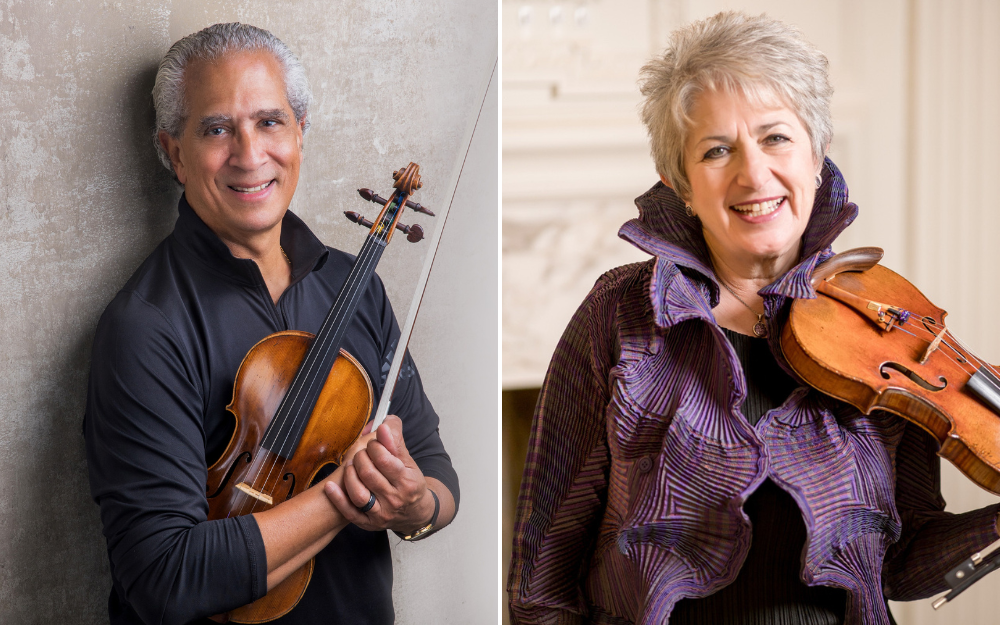
Music Director Guillermo Figueroa plays the role of conductor as well as soloist for this concert! Joining him is his long-time friend and renowned violinist Ida Kavafian for Mozart’s grand Sinfonia Concertante. You’ll marvel at the interplay of melodies between these two musicians. Next, Ida and The Symphony perform the regional premiere of Richard Danielpour’s Fiat Lux. Finally, Rachmaninoff’s Symphonic Dances closes the concert. One of the composer’s last works, the piece features an optimistic personality with rhythmic drive and energy.
Internationally acclaimed as a violist as well as a violinist, the versatile Ida Kavafian is an artist-member of the Chamber Music Society of Lincoln Center and former violinist of the Beaux Arts Trio. For 34 years she has been artistic director of Music from Angel Fire in New Mexico, where some 200 Curtis students have participated in the Young Artist Program to date. She was a founder of the Bravo! Colorado festival, serving as its artistic director for ten years; and co-founded the chamber ensembles Opus One, Tashi, and Trio Valtorna. She also performs as a soloist and in recital with her sister, violinist Ani Kavafian.
Ms. Kavafian has premiered numerous works, including concertos by Toru Takemitsu and Michael Daugherty, whose Fire and Blood she recorded with the Detroit Symphony. She has toured and recorded with jazz artists Chick Corea and Wynton Marsalis, and with fiddler/composer Mark O’Connor.
Born in Istanbul of Armenian parentage, Ms. Kavafian is a graduate of the Juilliard School, where she studied with Oscar Shumsky. She made her debut through Young Concert Artists with the pianist Peter Serkin, and also received the coveted Avery Fisher Career Grant. She resides with her husband, violist Steven Tenenbom, in Philadelphia and Connecticut, where they breed and train prizewinning Hungarian vizsla show dogs.
Since 1998 Ms. Kavafian has served on the faculty of the Curtis Institute of Music, where she received the 2013 Lindback Foundation Award for Distinguished Teaching. She also teaches at the Juilliard School and the Bard College Conservatory of Music.
A sinfonia concertante is similar to a concerto, but instead of setting an individual soloist with virtuoso display passages in opposition to the orchestra, a sinfonia concertante integrates its soloists (usually two or more) more fully into the orchestral texture: The soloists rise from the orchestra and then return to it. Mozart’s Sinfonia Concertante for Violin and Viola dates from the autumn of 1779, when the composer, then 23, was in his final years of service to the Archbishop of Salzburg. Little is known about its composition, but what is clear is that this is one of Mozart’s greatest works: noble in conception and content, utterly assured in technique and, in the slow movement, charged with a dark, romantic intensity.
The writing for both violin and viola is at every moment idiomatic and grateful. The relation between the two solo instruments is particularly interesting. Only rarely do they play together. They exchange material, answer one another, take up a phrase the other has just left off, and sometimes the flow of phrases between them is brilliant.
The opening Allegro maestoso is well named, for this truly is majestic music, and it unfolds with sovereign ease. An orchestral introduction leads to the masterful entrance of the soloists: Mozart slips them in almost unnoticed; one suddenly becomes aware that they are playing. This long opening movement is based on six different themes. There is a particular quality to this music that is almost impossible to define: The mood may be relaxed, but throughout this movement one feels the breadth, ease, and strength of Mozart’s musical imagination at its most powerful. Just before the close, the two instruments share a cadenza, and Mozart writes it out himself rather than leaving it to the soloists.
Great as the first movement is, it finds its equal in the Andante, which shifts to C minor. The orchestra announces the dark, almost grieving main idea, and the soloists quickly take it up. Their development of this yearning, lamenting music is one of the glories of Mozart’s music, and among the most impressive things is this music’s rhythmic imagination: There are turns, trills, dotted rhythms, and decorations in nearly every measure. Once again, Mozart writes out a cadenza just before the close.
The concluding rondo-finale, marked Presto, zips along happily, powered by the trills that decorate its main theme. This is the most brilliant of the movements, with the interplay between violin and viola particularly crisp. There is no cadenza, but each instrument gets the chance to say farewell just before the orchestra brings this noble music to a conclusion.
Richard Danielpour has had a distinguished and prolific career as a composer. He trained at Oberlin and the New England Conservatory before going on to Juilliard, where he studied composition with Vincent Persichetti and Peter Mennin. His catalog of compositions includes stage works (ballets and two operas), orchestral music (three symphonies and numerous concertos), seven string quartets and other chamber music, vocal music, and works for the piano. Danielpour has taught at the Manhattan School of Music, the Curtis Institute, and UCLA.
Fiat Lux was commissioned by Susan DeJong and the Curtis Institute of Music in honor of Richard Danielpour, Ida Kavafian, and Curtis’ Centennial Year. The work is, in Danielpour’s words, ”a love letter to Curtis,” and he dedicated it to Ida Kavafian, who is the school’s Nina von Maltzahn Chair in Violin Studies. Composed in 2024, Fiat Lux was premiered at Curtis on March 15, 2025, with Ida Kavafian as violin soloist and with Earl Lee conducting.
Scored for violin soloist, strings, and a large percussion section, Fiat Lux is in three movements that span about 25 minutes. The title translates “Let There Be Light,” and Fiat Lux may be thought of as an optimistic piece, a statement of faith in life’s possibilities. The composer has spoken about his intentions in this music: “The work, as its Latin title implies, is all about the choice for light in the face of the darkness, deception, and the lack of good will that often surrounds us from time to time within the world we live. The second movement, which is the heart and turning point of the work, offers the listener a way out of conflict and discord, with love, forgiveness and reconciliation as an option.”
All three movements are without titles, but Fiat Lux takes the general shape of a traditional concerto, with two active outer movements surrounding a lyric central movement. The opening movement combines equal measures of contemplation and energy, while the finale is an energetic rondo-like structure that brings the work to a firm close. The slow central movement, as the composer has noted, is the “heart” of the work, rising gradually to a powerful climax and coming finally a shimmering close.
Perhaps the final word should be left to the composer: “The light becomes even more important in times of confusion and disorder and darkness. I wrote this piece, as I’ve written many of my works, knowing that music, in a way, is the last bastion of being able to stay in touch with our humanity. I’ve always felt that it has the potential ability not only to open us up emotionally but also to act as a catalyst for healing.”
Rachmaninoff spent the summer of 1940 at Orchard Point, a 17-acre estate on Long Island that had groves, orchards, and a secluded studio where he could work in peace. There, he set to work on what would be his final complete work, a set of dances for orchestra. By August, he had the score complete in a version for two pianos and, because he regarded this as a dance score, he consulted with choreographer Mikhail Fokine. Rachmaninoff tentatively titled the piece Fantastic Dances and gave its three movements names—Noon, Twilight, and Midnight—that might suggest a possible scenario. Fokine liked the music when Rachmaninoff played it for him, and they began to look ahead to a ballet production, but Fokine’s death shortly afterwards ended any thought of that. By the end of the summer, Rachmaninoff appears to have rethought the character of this music. By the time he completed the orchestration several months later, he had changed its name to Symphonic Dances and dropped the descriptive movement titles.
This score is remarkable for the opulence of its color, and Rachmaninoff seems intent here on finding and exploiting new orchestral sonorities. Some of these are completely new sounds for him (such as his use of an alto saxophone), but more comes from his refined use of standard instruments, such as the contrasting sound of stopped, open, and muted brass in the second movement or the striking cascades of open-string figures in the last. For all their sumptuous sound, though, the Symphonic Dances are more remarkable for Rachmaninoff’s subtle compositional method. Rather than relying on the “Big Tune,” he evolves this music from the most economical of materials—rhythmic fragments, bits of theme, simple patterns—which are then built up into powerful movements that almost overflow with rhythmic energy.
The music opens with some of these fragments, just bits of sound from the first violins, and over them the English horn sounds the three-note pattern that will permeate the Symphonic Dances, reappearing in endless forms across the span of this score. Rachmaninoff plays it up here into a great climax, which subsides as the opening fragments lead to the central episode, sung at first entirely by woodwinds. This slow interlude (somehow the reedy sound of the alto sax is exactly right for this wistful music) makes its way back to the big gestures of the beginning section, now energized by explosive timpani salvos. In the closing moments, Rachmaninoff rounds matter off with a grand chorale for strings, beautifully accompanied by the glistening sound of bells, piano, harp, piccolo, and flutes, and the movement fades into silence on the fragments with which it began.
The opening of the second movement takes us into a completely different sound-world, for Rachmaninoff begins with the icy sound of trumpets and horns, played forte but stopped. This movement is marked Tempo di valse, the only explicit dance indication in the score. Fokine himself warned Rachmaninoff not to feel bound to “dance” music (and specifically to waltz music) when writing music for dancing; if the music had vitality and character, Fokine would find a way to make it work as a ballet. This waltz evolves through several episodes—some soaring, some powerful—before the movement subsides to a sudden, almost breathless close.
The slow introduction to the final movement is enlivened by the strings’ interjections of the three-note pattern. Gradually these anneal into the Allegro vivace, and off the movement goes, full of rhythmic energy and the sound of ringing bells. A central episode in the tempo of the introduction sings darkly (Rachmaninoff marks it lamentoso); there are some wonderful sounds here, including great eerie string glissandos, and finally the Allegro vivace returns to rush the Symphonic Dances to the close. Some unexpected features emerge: a quotation from Rachmaninoff’s First Symphony (composed nearly 50 years earlier), the liturgical chant “Blessed Be the Lord,” and that old Rachmaninoff obsession, the Dies Irae.