October 18, 2026
4 PM | Lensic
Schubert &
The Bells
The Santa Fe Symphony Orchestra
The Santa Fe Symphony Chorus
Guillermo Figueroa, Music Director
Carmen Flórez-Mansi, Choral Director
Diana Newman, Soprano
Ricardo Garcia, Tenor
Aleksey Bogdanov, Baritone
Program
SCHUBERT
Symphony No. 8, “Unfinished”
SAINT-SAËNS
Danse macabre, op. 40
RACHMANINOFF
The Bells, op. 35
Diana Newman, Soprano
Ricardo Garcia, Tenor
Aleksey Bogdanov, Baritone
Runtime: Approx. 1 hour 40 minutes, with one intermission.
FULL CONCERT UNDERWRITER
Boo Miller
REACH FOR THE STARS
Ann Dederer & William Seale
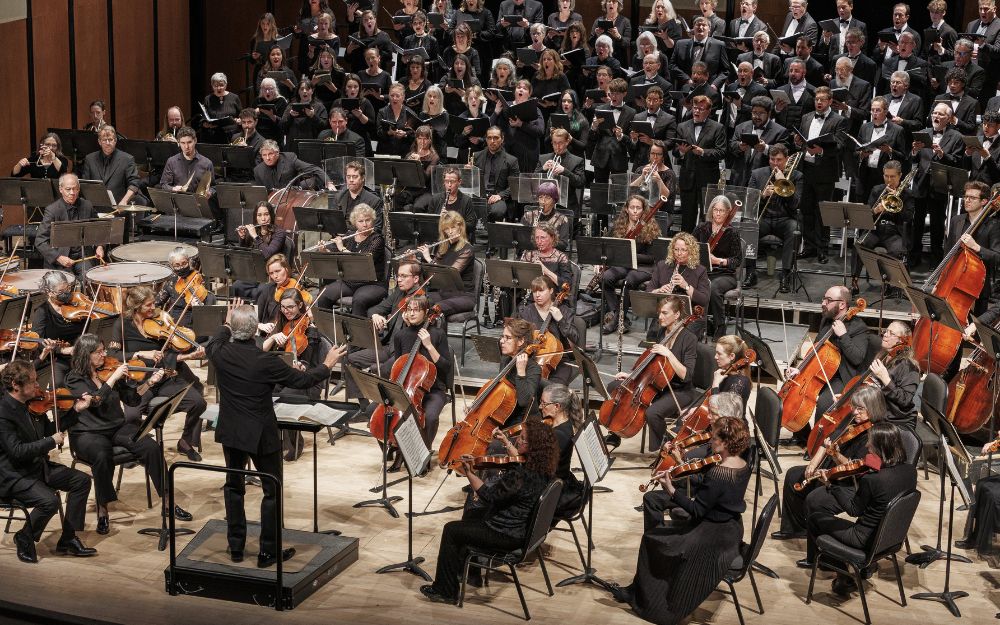
October is the perfect time for music with spooky and gothic origins. The concert opens with Schubert’s mysterious & romantic “Unfinished” Symphony No. 8. Next is Saint-Saëns’ Danse macabre, a tone poem depicting Death fiddling on Halloween as skeletons dance on their graves. To close the concert, The Santa Fe Symphony Chorus, under the direction of Carmen Flórez-Mansi, and a trio of exceptional soloists, join The Symphony to perform Rachmaninoff’s The Bells. Inspired by Edgar Allan Poe’s famous poem, this choral work brings the fabled bells—sleigh, wedding, alarm, and finally funeral—to life.
This performance will be sung in English.
American soprano Diana Newman brings “fresh and intense” performances to opera houses and concert stages across the United States and Europe. Highlights of Newman’s 2025-26 season include a return to The Dallas Opera in the fall as Frasquita in Carmen, and in the spring as The Water in The Little Prince. She will also perform Bernstein’s Symphony No. 3 “Kaddish” and the Beethoven Choral Fantasy with the Florida Orchestra.
In the 2024-25 season, Newman performed in the North American premiere of Missy Mazzoli’s The Listeners with Opera Philadelphia in the role of Danica, debuted with Atlanta Opera as Erste Dame in Die Zauberflöte, and performed Bernstein’s Symphony No. 3 “Kaddish” with the Orchestra of St. Luke’s under the baton of James Conlon.
Newman’s 2023-24 season included a number of major symphonic appearances, including the world premiere of Aaron Zigman’s Émigré with the Shanghai Symphony, followed by the piece’s US premiere with the New York Philharmonic, a program entitled Hisaishi Conducts Hasiashi with the Chicago Symphony Orchestra, A Century of Film Music with the Los Angeles Philharmonic, conducted by her father, David Newman, and her debut with the Boston Symphony Orchestra at Tanglewood as Woglinde in Götterdämmerung.
Diana began her 2022-23 season with the Baltimore Symphony Orchestra as the soprano soloist in Bernstein’s Kaddish Symphony, before joining the Dallas Opera as Woglinde in Das Rheingold, and later in the season as Despina in Così fan tutteIn the 2021-22 season, Newman made her Metropolitan Opera debut as Papagena in Die Zauberflöte, as well as covered the role of Echo in Ariadne auf Naxos. She will join the Alabama Symphony Orchestra as the soprano soloist in Beethoven Ninth Symphony and sing the leading role of Clara in The Light in the Piazza with Central City Opera.
Newman began the 2019-20 season in her debut with the Dallas Opera as First Lady in The Magic Flute conducted by Music Director Emmanuel Villaume and joined the Metropolitan Opera Roster for the first time in December covering the role of Papagena in the same title. A recent graduate of the Lyric Opera of Chicago’s Ryan Opera Center, she returned for the company’s Ring Cycle, reprising her roles as Woglinde in Götterdämmerung and Woodbird in Siegfried, conducted by Sir Andrew Davis. Diana was seen as a soloist with the Los Angeles Philharmonic at the Hollywood Bowl for America in Space in celebration of the 50th anniversary of the Apollo 11 moon landing.
During her tenure at the Lyric Opera of Chicago, Diana performed the roles of Frasquita in Carmen, Pedro in Don Quichotte, Clorinda in La Cenerentola, Papagena in Die Zauberflöte, and as the Page in Verdi’s Rigoletto, a role she debuted with the Los Angeles Philharmonic under Gustavo Dudamel at the Hollywood Bowl. Additional recent performances include her house and role debuts at Palm Beach Opera as Adele in Die Fledermaus, as well as concert performances with the Rochester Philharmonic Orchestra for Carmina Burana and the Alabama Symphony for Beethoven’s Symphony No. 9. She made her house and role debuts covering the role of Sophie at the Glyndebourne Festival in the summer of 2018.
On the concert stage, Diana has recently appeared as a soloist in Maria Schneider’s Winter Morning Walks at the Lucerne Festival, Barber’s Knoxville: Summer of 1915 with the Eastern Sierra Symphony Summer Festival, and Vivaldi’s Gloria in Havana, Cuba. Additional concerts include Mozart’s Exsultate jubilate with the USC Alumni Orchestra, Bach’s “Cof ee” Cantata with the Whittier Bach Festival, and Mahler’sSymphony no. 4 in her debut with the American Youth Symphony. Her debut with the Grant Park Music Festival came in 2016, appearing as Curly’s Wife in Floyd’s Of Mice and Men.
Committed to the performance of art song and new works, Diana has attended numerous programs including the Ravinia Festival Steans Music Institute, SongFest, and the Fall Island Vocal Arts Seminar run by Stephanie Blythe. In 2014 she performed at Carnegie Hall in a master class led by legendary mezzo-soprano Christa Ludwig as part of the Marilyn Horne Song Continues series. She performed George Crumb’s Madrigals Book IV at Music Academy of the West, Frank Ticheli’s Songs of Love and Life and Angels in the Architecture with the UT New Music Ensemble, and Lukas Foss’s Time Cycle with faculty members of the Aspen Music Festival, where she also covered the role of Daisy Buchanan in John Harbison’s The Great Gatsby. She has given multiple premieres of works by living composers, including Francesco Cilluffo, Dr. Alan L. Smith, and David Newman.
Ricardo Garcia is thrillingly described as possessing a voice, “at times lilting and lyrical, at times intense with excitement” by KWMR FM. In the 2025-26 season, he returns to Florida Grand Opera as Alfred in Die Fledermaus. He also sings his first performances of Verdi’s Requiem with the Chattanooga Symphony Orchestra and Puccini’s Messa di Gloria with the Neue Rheingauer Kantorei in addition to returning to Handel’s Messiah with the Pacific Chamber Orchestra and Opera Laguna. He spent the past two seasons in the Ensemble of the Staatststheater Darmstadt at which his performances included Lenski in Eugene Onegin, Alfredo in La traviata, Cassio in Otello, Oronte in Alcina, Andres in Wozzeck, Alfonso in Le muette de Portici, and the Shepherd in Tristan und Isolde. Also during those two years, he returned to the States for his first performances of Tamino in Die Zauberflote with Florida Grand Opera and joined the New World Symphony as the Father in Weill’s Seven Deadly Sins. He also returned to Wolf Trap Opera as Nikolaus Sprink in Puts and Campbell’s Silent Night and for Beethoven’s Symphony No. 9 with the National Symphony Orchestra.
His recent performances include Roméo in Roméo et Juliette and Fabrizio Naccarelli in The Light in the Piazza with Central City Opera, further performances of Roméo in Roméo et Juliette with Boston Lyric Opera, Grimoaldo in Rodelinda at the Aspen Music Festival, and Valcour in L’amant anonyme with Wolf Trap Opera.
Ricardo Garcia is a former Butler Studio Artist of Houston Grand Opera. While with the company, he sang Alfredo in La traviata, Roméo in Roméo et Juliette, Third Jew in Salome, Remendado in Carmen and Papi and Jasper in the world premiere of Thompson’s Snowy Day, Schmidt in Werther, First Commissioner in Dialogues des Carmélites, Hans Sachs’ Trainer in Little’s Vinkensport, in addition to covering Tamino in Die Zauberflöte.
He was a Resident Artist of Portland Opera where he sang Bill in A Hand of Bridge and Donald Hopewell in Gallantry and covered Andronico in Bajazet. He joined Music Academy of the West as Jenik in The Bartered Bride, Opera on the James as Fenton in Falstaff, and Tulsa Opera as the Lamplighter and Drunkard in The Little Prince.
Mr. Garcia earned his Master of Music Degree at San Francisco Conservatory of Music, at which he sang a host of leading roles, including the Male Chorus in The Rape of Lucretia, Peter Quint in The Turn of the Screw, Bajazet in Tamerlano, Le Mari in Les mamelles de Tiresias, Houssar in Mavra, the title role of Bastianello, Lorenzo in Musto’s Lucrezia, and Younger Thompson in Cipullo’s Glory Denied. He was also an Apprentice Artist at Santa Fe Opera and a previous Studio Artist at Wolf Trap Opera.
On the concert stage, Mr. Garcia has sung Handel’s Messiah with the Pacific Chamber Orchestra, Beethoven’s Symphony No. 9 with the Eureka Symphony, and Gonzalez‘s Misa Azteca with the Rogue Valley Chorale. While at Wolf Trap Opera, he was tenor soloist in the company’s Bernstein at 100 concert with the National Orchestral Institute. He has been presented in solo recital by Castro Valley Performing Artist and as a distinguished alumnus of Songfest.
He is a 2020 winner of the Metropolitan Opera National Council Auditions New Orleans and Puerto Rico District. Previously in the competition he has won in the San Francisco District and has received encouragement awards at the district level. Prior to earning his Master of Music degree from San Francisco Conservatory, he completed his Bachelor of Arts from the University of the Pacific. Prior to beginning his operatic career, he played professional baseball with the Storm, a high independent league affiliate for the Milwaukee Brewers.
Baritone Aleksey Bogdanov is celebrated for his powerful voice and compelling stage presence, earning acclaim across major opera houses worldwide. His 25/26 season includes debuts with The Atlanta Opera in Götterdämmerung (Alberich/Gunther cover) and San Diego Opera in Carmen (Escamillo), as well as returns to San Francisco Opera for Rigoletto (Il Conte di Monterone), The Metropolitan Opera for Arabella (Mandryka cover), and Lyric Opera of Chicago for Salome (Erster Nazarener/Jochanaan cover). Future seasons include a return to his home company, San Francisco Opera.
In the 24/25 season, he made his debut with Pacific Symphony in a staged production of Das Rheingold (Donner), and returned to The Metropolitan Opera for Die Frau ohne Schatten (Der Einäugige) and Pique Dame (Tomsky cover), San Francisco Opera for Un ballo in maschera (Renato cover) and Tristan und Isolde (Kurwenal cover), Palm Beach Opera for Roméo et Juliette (Capulet), and The Glimmerglass Festival for The Rake’s Progress (Nick Shadow). On the concert stage, he appeared with the Cathedral Choral Society in Ethel Smyth’s Mass in D and with The Clarion Choir in Rachmaninoff’s Spring Cantata.
Recent operatic highlights include debuts at Gran Teatre del Liceu in Les Contes d’Hoffmann (Crespel/Luther), Royal Swedish Opera in La fanciulla del West (Rance), and performances of Tosca (Scarpia) with companies including Kaohsiung Philharmonic Cultural & Arts Foundation, Palm Beach Opera, Austin Opera, and Hawaii Opera Theatre. He has also sung the title role in Rigoletto with Nashville Opera and Central City Opera; Madama Butterfly (Sharpless) with Tulsa Opera; Aida (Amonasro) with Boston Youth Symphony Orchestras; Tiefland (Sebastiano) with Sarasota Opera; La fanciulla del West (Rance) with Opera Carolina; and Hérodiade (Vitellius) with Washington Concert Opera.
Additional engagements include Lohengrin (Telramund cover) at San Francisco Opera, Tosca (Scarpia) at Arizona Opera, The Nose (Kovalyov) in a new Francesca Zambello production at Chicago Opera Theater, Un ballo in maschera (Renato) at Maryland Lyric Opera, and Silent Night (Lt. Horstmayer) at Washington National Opera. He made his Metropolitan Opera debut in Boris Godunov (Shchelkalov).
On the concert stage, Bogdanov has performed Verdi’s Requiem and Boris Godunov (Shchelkalov) with San Diego Symphony under Michael Tilson Thomas, Gurre-Lieder (Peasant/Narrator) with KBS Symphony Orchestra, Rachmaninoff’s The Bells with the Cathedral Choral Society at Washington National Cathedral, A Hand of Bridge (Barber) with Baltimore Symphony Orchestra, Verdi’s Requiem with Colorado Symphony and The Phoenix Symphony, and Messiah with Richmond Symphony.
A graduate of the Cafritz Young Artist Program at Washington National Opera, he performed over 100 times with the company in roles such as Carmen (Escamillo), Hansel and Gretel (Peter), Le nozze di Figaro and Don Giovanni (title roles), Così fan tutte (Guglielmo), L’elisir d’amore (Belcore), Madama Butterfly (Sharpless), and Appomattox (George Wallace). He made his Glimmerglass Festival debut in Carmen (Escamillo), a signature role he has since performed with The Atlanta Opera, Opera Theatre of Saint Louis, and Columbus Symphony Orchestra. He later returned to Glimmerglass for Madama Butterfly (Sharpless) and Picker’s An American Tragedy (Samuel Griffiths).
Other notable performances include his Canadian debut in the title role of Eugene Onegin with Edmonton Opera, and his Carnegie Hall debut as bass soloist in Messiah. He has appeared as soloist in Mozart’s Requiem at Place des Arts (Montréal), Beethoven’s Fidelio with the National Symphony Orchestra, Castelnuovo-Tedesco’s Romancero Gitano at Palau de les Arts Reina Sofia and Teatro Baretti di Torino, Dvořák’s Te Deum and Janáček’s Glagolitic Mass at the Basilica of the National Shrine, and the Requiems of Mozart, Fauré, and Duruflé at Washington National Cathedral.
Although this symphony is known as the “Unfinished,” Schubert actually wrote a number of other unfinished symphonies; there are existing fragments of five other symphonies that he began but abandoned. This piece was written in the fall of 1822, when Schubert was 25. He began work on October 30 and completed two movements in November; he then began a third movement, a scherzo, sketching out 129 measures and fully orchestrating the first nine. And then he stopped. The following year he had the manuscript delivered to his friend, the composer Anselm Huttenbrenner, possibly as a
gesture of appreciation for having been inducted into the Styrian Music Society of Graz, of which Huttenbrenner was also a member. At that point, Schubert apparently forgot about the symphony, and he never heard it performed.
The manuscript came to light in 1865 when conductor Johann Herbeck was visiting Huttenbrenner and inquired about the existence of any Schubert manuscripts. Huttenbrenner showed this symphony to Herbeck, who led the premiere in Vienna on December 17, 1865. From that moment, it has been one of the most popular pieces of music ever written.
Despite its odd form—two movements instead of the customary four—the symphony is a fully satisfying musical experience. Its two massive movements, both at a fairly moderate tempo, offer the unusual combination of lyricism and monumentality: lyrical because this symphony is built on some of the most easily sung tunes in classical music; monumental because of Schubert’s ability to transform these melodies into music of stature and power. Many other features contribute to the music’s appeal. Chief among these is Schubert’s control of orchestral color; three trombones give the music unusual
weight, but even more impressive are the many shades of instrumental color he achieves through subtle handling of solo winds. Also impressive is the ease of Schubert’s harmonic language. This music glides effortlessly between unexpected keys, with the effect of delicately shifting patterns of light. A haunting, somber beauty runs through both movements.
There have been many theories on why Schubert did not finish this symphony. In The Victor Book of the Symphony (1935), Charles O’Connell offers, in quite purple prose, the conclusions of one generation: “[the “Unfinished”] is utterly perfect in finish. It leaves nothing unsaid. It explores the most
mysterious regions of the human soul and heart. In language of inexpressible beauty it communicates from composer to hearer an intensity of passionate emotion, a degree of spiritual exaltation, a completely satisfying and wholly expressive message. Music can go no further; Schubert himself, having said in these two movements all that even he, with his almost inexhaustible flow of melodious expression, could say, gave over the task of writing two more sections.”
Closer to our own day, and in a more realistic explanation, musicologist and Schubert expert Maurice J.E. Brown has noted that Schubert contracted syphilis in the fall of 1822 while working on this symphony and was critically ill throughout 1823. Brown suggests that when Schubert recovered his health
a year later, the sensitive composer identified this music so closely with that illness that emotionally he was unable to resume work on it.
Although we don’t have a definitive answer to why Schubert didn’t complete the symphony, it’s unlikely that the millions of people who have loved this music have ever considered it “unfinished.”
In 1873, Saint-Saëns wrote a song that set a spooky poem by Henri Cavalis to music. In the poem, the souls of the dead come to life at midnight and dance their way through a black sabbath as Death plays his violin. Cavalis’ poem has been translated freely: “Zig, zig, zig, Death is striking a tomb with his heel in cadence. Death is playing a dance tune on his violin at midnight. The winter wind blows, and the night is dark. From the linden-trees come moans. White skeletons move across the shadows, running and leaping in their shrouds. Zig, zig, zig, each one gives a tremor, and the dancer’s bones rattle. Hush! They leave off dancing, they jostle one another, they flee—the cock has crowed.”
Saint-Saëns was dissatisfied with his song and thought it was unsingable, so the following year he recast the music as a tone poem for orchestra. (He could not have known that just a few years earlier and far to the east, Mussorgsky had composed a very similar portrait of diabolical revelry, Night on Bald Mountain.) Premiered in Paris on January 24, 1875, Danse Macabre quickly became one of Saint Saëns’ most popular works.
It opens as the harp sounds the 12 strokes of midnight, and Death promptly tunes his violin. He doesn’t get it quite right, however, for he tunes his E-string a half-step flat. The resulting discord is a tritone (three whole steps, or a diminished fifth), infamous from medieval times as the sound of the devil; as a result, it was banned in some music.
Here Saint-Saëns lets that discord ring out stridently, and the Devil quickly launches into his waltz. Soon we hear the sound of dancing skeletons, nicely suggested by the rattle of the xylophone, and Saint-Saëns builds his dance with skill, treating it fugally at one point and combining his two main
themes at the climax. It then breaks off into silence, and the crow of a distant rooster, represented by solo oboe, suggests the coming of dawn. The spirits cringe before the light but quickly bow to the inevitable, return to their graves, and the music winks out before us.
In the summer of 1912, Sergei Rachmaninoff received an anonymous letter suggesting that Edgar Allan Poe’s poem The Bells would make an ideal text for a musical setting and further suggesting that Rachmaninoff would be exactly the composer to do it. Intrigued by both the suggestion and its
mysterious source, Rachmaninoff looked up the poem and was immediately enthusiastic about the idea. The following winter he took his family to Rome, where he rented a room near the Piazza de Spagna. That room had once been occupied by Modeste Tchaikovksy, who was often visited there by his brother, the composer Peter. In that room Rachmaninoff composed The Bells in the early months of 1913, completing the orchestration in July after he had returned to the family estate near Moscow. Years later, the author of the mysterious letter was revealed: She was a shy young cello student who
was reported to have wept with joy when she heard a performance of The Bells.
Poe’s poem, with its verbal exploration of different bell-sounds, found a sympathetic reader in Rachmaninoff, who spoke of his own deep response to the sound of bells: “The sound of church bells dominated all the cities of Russia I used to know–Novgorod, Kiev, Moscow. They accompanied every Russian from childhood to the grave, and no composer could escape their influence . . . All my life I have taken pleasure in the differing moods and music of gladly chiming or mournfully tolling bells . . . In the drowsy quiet of a Roman afternoon, with Poe’s verses before me, I heard the bell voices, and tried to set down on paper their lovely tones that seemed to express the varying shades of human existence. And there was the added stimulus of working in the same room where Tchaikovsky worked, of
writing on the table on which he had written.”
The text that Rachmaninoff had before him, however, was not the original Poe, but a Russian translation by the poet Konstantin Balmont. For performances in English, the text has to be re-translated back into English in such a way that it fits the rhythms of Balmont’s Russian version, and as a result the English text sung at these concerts is some distance removed from the wonderful language of Poe’s original.
Each of the four movements depicts a different stage of life, and each of these is associated with a different kind of bell. The opening movement, which (in Poe’s original) begins:
“Hear the sledges with the bells – Silver bells!What a world of merriment their melody foretells!” features a tenor soloist and the sound of silver sleigh bells, which Rachmaninoff associated with the happiness of youth.
The second movement, beginning:
Hear the mellow wedding bells – “Golden bells! What a world of happiness their harmony foretells!” presents a soprano soloist and the sound of golden wedding bells, symbolizing the happiness of the lovers.
With the third movement, the tone changes sharply. This movement opens:
“Hear the loud alarm bells – Brazen bells! What a tale of terror, now, their turbulency tells!” The wildly ringing bronze firebells signal the inevitable assaults and struggles of life.
The final movement (marked “Slow and lugubrious”) begins:
“Hear the tolling of the bells – Iron bells! What a world of solemn thought their monody compels!”A dark English horn solo sets the somber mood here, and solo baritone and iron funeral bells foretell man’s final destination, the loneliness of the tomb.
The poem’s progression from the merry chiming of the beginning to the fateful tolling at the end appealed strongly to Rachmaninoff’s own fatalism, and he was able to make the sounds of the orchestra echo what he believed were the inevitable stages of human progress. He tried to recreate these bell-sounds with only sparing use of actual bells; instead, he used delicate woodwind chords, string sforzandos, and heavy brass chords to suggest the sounds of particular kinds of bells.
Rachmaninoff was uncertain how to classify The Bells. On one occasion he called it a choral symphony; on another he said it was a poem for orchestra. Whatever the form, he was very pleased with the composition, and late in life he called it his favorite among all his compositions.
Violin I
David Felberg
Ruxandra Marquardt
Alan Mar
Elizabeth Young
Carol Swift
André Dos Santos Silva
Rebecca Callbeck
Natalie Frantz Wade
Megan Holland
Jessica Retana
Violin II
Nicolle Maniaci
Sheila McLay
Anne Karlstrom
Lidija Peno-Kelly
Justin Pollak
Carla Kountoupes
Valerie Turner
Gloria Velasco
Sarah Lee
Viola
Kimberly Fredenburgh
Laura Steiner
Lisa DiCarlo
Allegra Askew
Christine Rancier
Sigrid Karlstrom
Michael Anderson
Erin Dryer
Cello
Dana Winograd
Jessamyn Fry
Allison Rich
Melinda Mack
Lisa Collins
Ian Brody
Amy Huzjak
Bass
Terry Pruitt
Sam Brown
Frank Murry
Mark Tatum
Zachary Bush
Flute
Laura Dwyer
Valerie Potter
Jennifer Lau
Cassandra Gunn
Oboe
Rebecca Ray
Kevin Darrow
Jillian Kouzel
James Abbott
Clarinet
Lori Lovato
Emily Erb
Sarah Jaegers
Jeff Brooks
Bassoon
Stefanie Przybylska
Samantha Brenner
Levi Walsh
Tim Wells
Horn
Daniel Nebel
Andrew Meyers
Peter Erb
Allison Tutton
Michael Lombardi
James Wilson
Trumpet
Brynn Marchiando
Alexander Hardin
Addison Bosch
Trombone
Noah Eder
Christopher Buckholz
Bass Trombone
Gerry Pagano
Tuba
Richard White
Timpani
Ken Dean
Percussion
Jeff Cornelius
Scott Ney
Alexis Corbin
Richard Kelly
Carolina Munoz
Harp
Karyn Wouden
Celeste
Michelle Schumann
Piano
Luke Gullickson