
December 6, 2026
4 PM | Lensic
Sounds of the Season
The Santa Fe Symphony Orchestra
The Santa Fe Youth Symphony Orchestra
Guillermo Figueroa, Music Director
William Waag, Director of Youth Orchestras
Program
VIVALDI
The Four Seasons – IV. Concerto No. 4 in F minor, op. 8, RV 297, “Winter” (L’inverno)
Guillermo Figueroa, Violin
TCHAIKOVSKY
Selections from The Nutcracker Suite
FREDRICK DELIUS
Winter Night (Sleigh Ride)
SAMUEL COLERIDGE-TAYLOR (arr. BAYNES)
Christmas Overture
Side-By-Side with
The Santa Fe Youth Symphony Orchestra
arr. PETER JAFFE
Symph-Hanukkah
JAMES M. STEPHENSON
A Charleston Christmas
TRADITIONAL ENGLISH SONG
“The Holly and The Ivy”
JAMES M. STEPHENSON
Holly Jolly Sing Along
Full Concert Sponsors
Margaret & Barry Lyerly

Concert Sponsors-In-Part

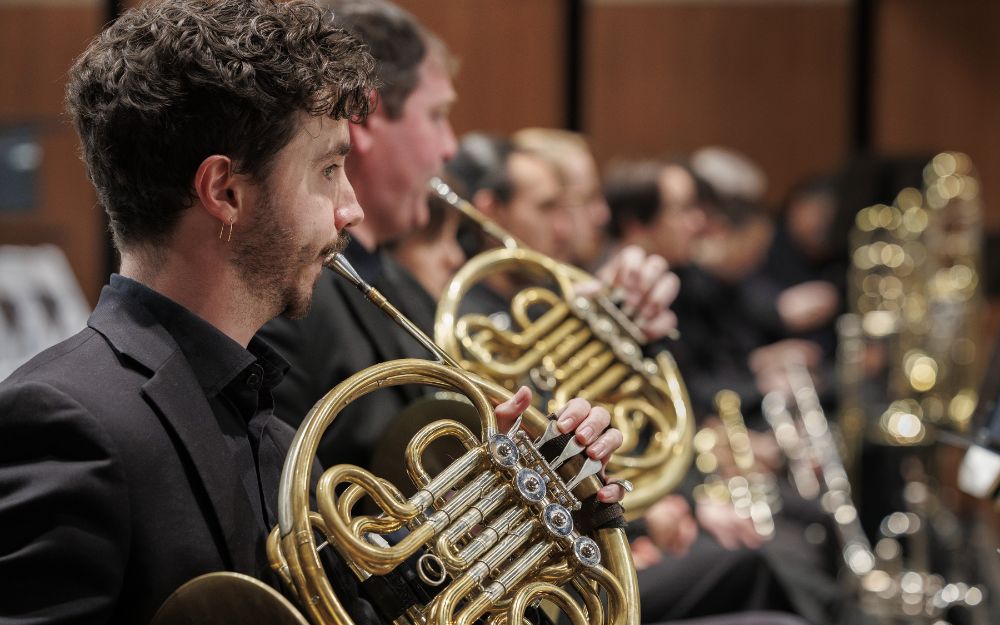
‘Tis the season for joyful music! Led by Maestro Figueroa, The Santa Fe Symphony presents a brilliant program packed with seasonal and holiday favorites! Featuring wintery works from Tchaikovsky and Vivaldi as well as popular tunes, there’s something for everyone. We are thrilled to once again share the stage with The Santa Fe Youth Symphony Orchestra, led by William Waag. You will leave the concert beaming with holiday spirit!
William Waag is a passionate conductor and music educator in northern New Mexico and has led The Santa Fe Youth Symphony since 2014. He is The Santa Fe Symphony’s Director of Youth Orchestras, and is also the Principal Conductor of The Santa Fe Community Orchestra and The Los Alamos Symphony Orchestra.
As a guest conductor, William has led The Santa Fe Symphony, The Albuquerque Philharmonic, Seattle Rock Orchestra, Santa Fe Community Orchestra, Los Alamos Symphony, Mobile Symphony Youth Orchestra, El Paso Symphony Youth Orchestra, and All-Region Honor Orchestras in Texas, Alabama and New Mexico.
William has led wind and jazz ensembles, symphony orchestras, drumlines, classes in music education, music theory, music for students with special needs, and pre-school music. Above all, William’s deepest passion is the conducting youth symphonies and leading young musicians’ exploration of the symphonic world. Previously with youth orchestras in Washington and Alaska, William is elated to be leading both youth and adult symphonies in New Mexico.
William received an MM in Orchestral Conducting from Central Washington University, and a BM in Music Education from Boise State University.
With more than 1,000 recordings in existence, few classical works have been recorded as often as Vivaldi’s Four Seasons. Yet 50 years ago, hardly anyone had heard of the piece. It was a recording of this music that led to the revival of interest in baroque music after World War II, and today new recordings appear regularly. A mark of its popularity is that, in addition to the violin version, the current catalog lists arrangements for flute, recorder, trombone, brass quintet, guitar trio, electronic synthesizer, and koto ensemble.
The Four Seasons are the first four concertos in the set of 12 Vivaldi published in 1725 as his Opus 8, which he nicknamed Il cimiento dell’ armonia e dell’ inventione (“The Battle between Harmony and Invention”). Each of the four is a small tone poem depicting events of its respective season, and
in the published score Vivaldi printed the four anonymous sonnets his music was intended to depict. (However, the poems may have been written after the music was composed.) The Four Seasons are thus one of the earliest examples of “program music.” His fast movements tend to depict storms, while the slow movements are reminiscent of shepherds falling asleep. But this music is so infectious and appealing and the many little touches so charming, that The Four Seasons seems to have an air of eternal freshness.
Each of the four is in the standard form of Vivaldi’s concertos. The beginning of the fourth movement, Winter, or L’inverno, is one of the most effective moments in The Four Seasons: Quick turns in the orchestra “shiver” with the cold, and later vigorous “stamping” marks the effort to keep warm. In the wonderful Largo, a graceful, melodic violin line sings of the contented people who sit inside before a warm fire while outside raindrops (indicated by pizzicato strings) fall steadily. In the concluding Allegro, the solo violin shows those trying desperately to walk over ice. The ice shatters and breaks and strong winds blow, but Vivaldi’s music concludes with a sort of fierce joy. This is weather that, however rough, brings pleasure.
In 1891, the Maryinsky Theatre in St. Petersburg approached Tchaikovsky with a commission for a new ballet. They caught him at a bad moment: At age 50, Tchaikovsky was assailed by worries that he had written himself out as a composer, and—to make matters worse—they proposed a story line that the composer found unappealing: They wanted to create a ballet based on the E.T.A. Hoffmann tale Nussknacker und Mausekönig, but in a version that had been retold by Alexandre Dumas as Histoire d’un casse-noisette, and then furthered modified by the choreographer Marius Petipa. This sort of Christmas fairy tale, full of imaginary creatures set in a confectionary dreamworld of childhood fantasies, left Tchaikovsky cold, but he nonetheless accepted the commission.
Sidetracked by his American tour and his sister’s death, Tchaikovsky tried to resume work on the ballet when he returned to Russia. To his brother, he wrote: “The ballet is infinitely worse than The Sleeping Beauty—so much is certain.” The score was completed in the spring of 1892, and The Nutcracker was produced at the Imperial Theatre in St. Petersburg that December, only11 months before the composer’s death at 53. At first, it had only modest success, but its popularity grew so steadily that Tchaikovsky reassessed what he had created: “It is curious that all the time I was writing the ballet I thought it was rather poor, and that when I began my opera [Iolanthe] I would really do my best,” he wrote. “But now it seems to me that the ballet is good, and the opera is mediocre.”
Tchaikovsky could have had no idea just how popular The Nutcracker would become: It is an inescapable part of our sense of Christmas. This concert offers a selection of movements from the ballet, largely characteristic dances. March (also known as March of the Toy Soldiers) plays during a lively party scene, which includes dancing, games, and merriment. The fiery Russian Dance (also called Trepak) is a wild Cossack dance, while La mère Gigogne (roughly equivalent to The Old Woman Who Lived in a Shoe, and also called Mother Ginger and her Children) features dancing clowns. Tchaikovsky, who was an admirer of Johann Strauss, loved waltzes, and this selection includes one of his finest, The Waltz of the Flowers from Act II.
The idea of a sleigh ride through a wintry landscape on the way to a warm and comforting destination seems to have a universal appeal. Such a journey shows up in many different kinds of music, ranging from popular culture (“Over the River and Through the Trees, To Grandmother’s House We Go”) to some of the greatest classical composers. These include Mozart (“Sleigh Ride” from Three German Dances), Tchaikovsky (“The Journey through the Snow” from The Nutcracker), Sibelius (Night Ride and Sunrise), Prokofiev’s “Troika” from Lt. Kije Suite, and Leroy Anderson’s Sleigh Ride. Part of the charm of these musical representations is that they often include the sound of ringing sleigh bells.
English composer Frederick Delius originally composed the music that has come to be known as Sleigh Ride in 1887, while he was studying in Leipzig. Delius, then in his 20s, was encouraged by his friend Edvard Grieg. Delius wrote a short work for piano that he called Norwegian Sleigh Ride and played this for Grieg, who admired it. Two years later, in 1889, Delius orchestrated the piece and included it as the second of his Three Small Tone Poems; the work is also sometimes known as Winter Night. The piece gets off to a steady start with the sound of ringing sleigh bells, and flutes quickly sound the perky main theme. This opening energy soon gives way to an evocative portrait of moonlit, snowy landscapes. The opening music returns briefly, and Sleigh Ride vanishes into the moonlit forest.
Samuel Coleridge-Taylor was the illegitimate son of an Englishwoman and a medical student from Sierra Leone. His father, a descendant of slaves from North America, returned to Africa before his son was born, and his mother named the boy after the English poet Samuel Taylor Coleridge, reversing the poet’s final two names in the process. The boy was raised by his mother and her family, who taught Samuel to play the violin and encouraged him to make a career in music. His talent gave him entry at age 15 to the Royal College of Music, where he studied with Charles Villiers Stanford.
After graduation, he supported himself by composing, conducting, and teaching. He attracted the support of Edward Elgar, who recommended that the Three Choirs Festival commission a piece from him; this would be his Ballade in A Minor for orchestra, which helped establish his reputation.
Coleridge-Taylor was a prolific composer (his works include an opera, a symphony, a violin concerto, much orchestral and chamber music, incidental music, and keyboard pieces), but he died at age 37 of pneumonia that doctors believed was partly the result of overwork.
In 1910, Coleridge-Taylor was asked to provide incidental music for a children’s play based on Alfred Noyes’ The Forest of Wild Thyme, which Noyes subtitled “A Tale for Children Under Ninety.” He sketched some music for the production, but it was never used with the play, and the composer arranged several of its movements as short piano pieces. In 1925 (13 years after Coleridge-Taylor’s death) the English composer-conductor Sydney Baynes arranged some of these sketches as an orchestral piece titled Christmas Overture. This charming composition takes as its themes Christmas carols, including “Good King Wenceslas” and “Hark the Herald Angels Sing,” and others and turns them into a six-minute celebration of the Christmas season and of those timeless carols.